
conductive origami by yael akirav explores 3D printing onto textiles to turn on light
by 3D printing conductive filament directly onto the textile, the lights are turned on by contracting and stretching the structure.
prefer designboom on google[FEATURED]
inspired by origami folding techniques, yael akirav has developed ‘conductive origami’ that explores a new way of turning on light fixtures by using 3D printing of conductive filament, directly on textile. the rigid printing onto the textile allows the creation of complex elements and an array of different designs. when the printed material conducts electricity, the intersecting folds that stem from the art of origami present a new opportunity – turning on the light by contracting and stretching the structure.

vertical opening
image © ofek avshalom
the conductive filament is also used as the structural skeleton of the lighting fixtures, each with its own unique folding and opening method. whilst researching the project akirav realized that the filament can be used as a skeletal structure, which enables the folding and unfolding of each structure multiple times. during the next stage, the industrial designer combined the skeletal structure and the conductive trait, resulting in a unique way to light up the lamps.

vertical opening – the conductive filament allows a new way of lighting the lamp, by contracting and stretching the structure
image © ofek avshalom

round opening
image © ofek avshalom

round opening – the conductive filament offers a new way of lighting the structure
image © ofek avshalom

round opening – the conductive filament used as a dimmer mechanism
image © ofek avshalom

the project is inspired by origami folding techniques
image © ofek avshalom

image © ofek avshalom

material research – 3D printing directly onto textile
image © ofek avshalom
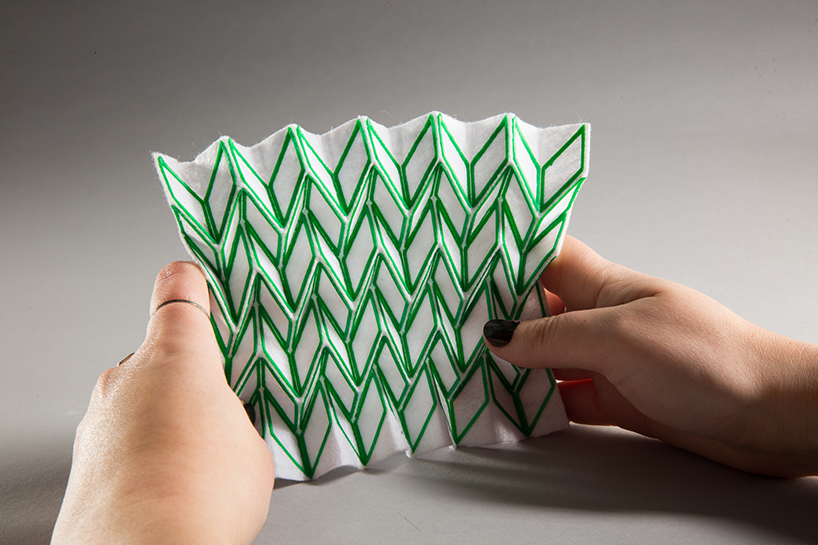
3D printing onto textile, the filament can be used as a skeletal structure
project info:
project name: ‘conductive origami’
design: yael akirav
photography: ofek avshalom
designboom has received this project from our ‘DIY submissions‘ feature, where we welcome our readers to submit their own work for publication. see more project submissions from our readers here.