
‘I can’t dominate it’: emmanuel boos on porcelain, failure, and the beauty of losing control
the french ceramicist reflects on the stubbornness of porcelain as he lets warps, puddles, and accidents bring strangeness to function.
prefer designboom on google[FEATURED]
toward a friendly relationship with chaos
At Raisonné in New York, Emmanuel Boos walks us through Noir C’est Noir like he’s introducing his crew of disorderly ceramic collaborators. The tables, stools, vases, and brick-like modules gathered for his first solo exhibition in the US all carry the discipline of porcelain, but they also keep the evidence of what happened when discipline gave way.
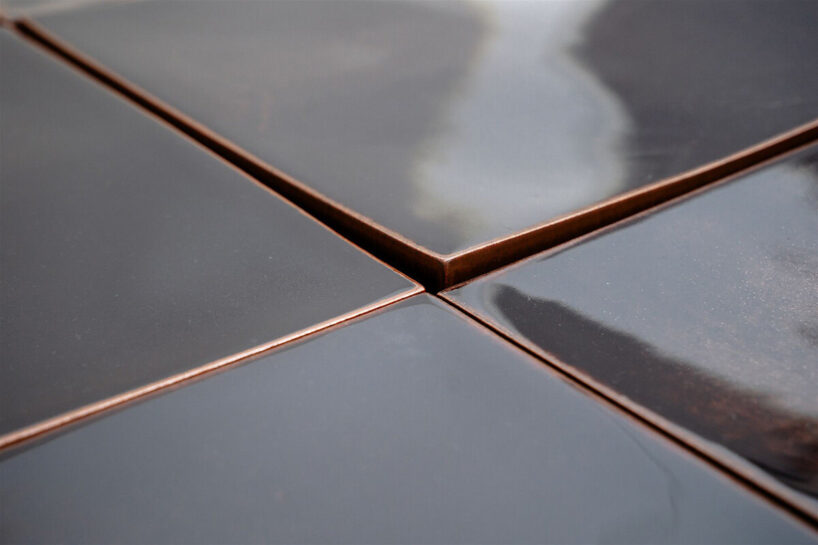
The ‘errors’ which the French ceramicist celebrates take the form of misaligned seams, pools of excess glaze, and slumping surfaces which lean onto each another for balance. Boos keeps returning to this thin space between intention and behavior, noting that the material behaves in ways he can not fully plan, but knows well enough to follow.

Emmanuel Boos first discovered ceramics during an exchange in the U.S., at a time when, as he remembers it, the medium held a different status in France. ‘I have some relation with the U.S., because that’s where I discovered ceramics,’ the ceramicist tells designboom at Raisonné’s New York gallery. ‘At that time, it wasn’t very popular in France. We’re very cerebral, we don’t do a lot of things with our hands.’
From there, his path moved through China and South Korea, then through apprenticeships in Paris and Burgundy. His later PhD at the Royal College of Art focused on glaze, a subject that still seems to sit at the center of everything he makes.

a material with a mind of its own
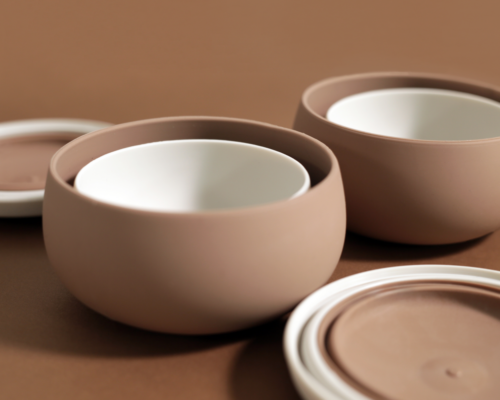
Porcelain, for Boos, is never a blank surface waiting to be controlled. ‘Porcelain is a very difficult and tricky material to work with,’ he says. ‘Some people say it lives, because it has its own mind and wants to do its own things. And it really does. It has a memory.’
A small pressure applied while forming a piece can reappear after firing, even once the mark seems to have been corrected. Rather than treat those returns as errors to hide, he allows them to become part of the object’s final presence. ‘I can’t dominate it. Those things always surface up again, and so I’m trying to get the best out of it.’

This acceptance came through years of resistance. Emmanuel Boos speaks of his own education in modernism, where still the concept of an artist or designer was someone who could dominate nature. ‘At my age, we were still educated with modernism,’ he says. ‘We still believed we could dominate nature. So it wasn’t that easy to come up with that thought then.’
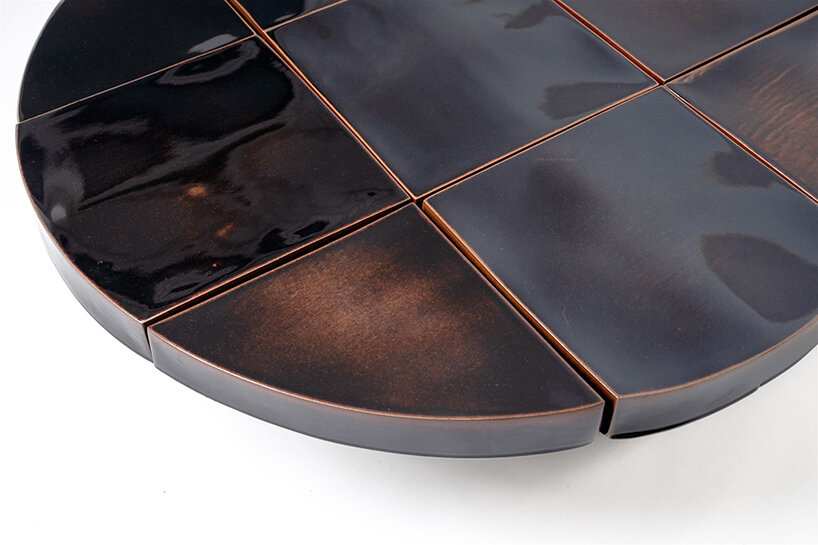
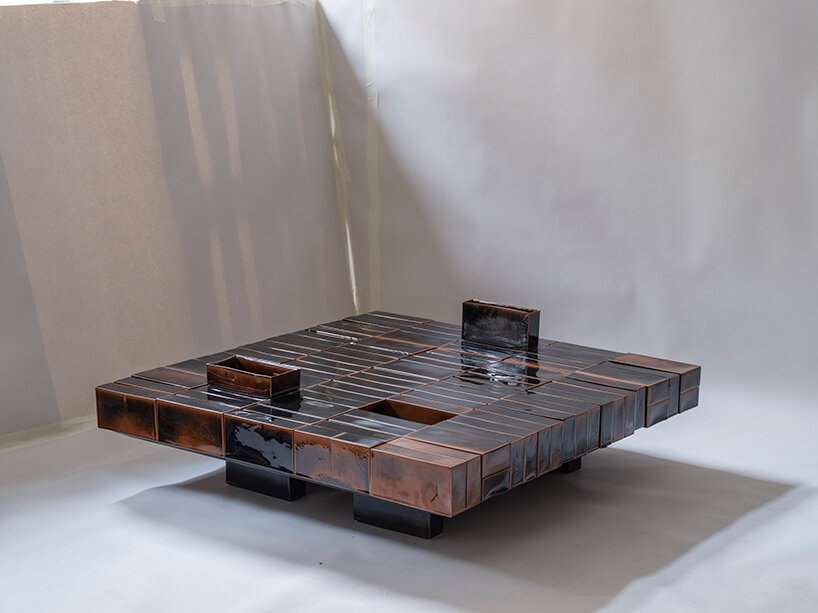
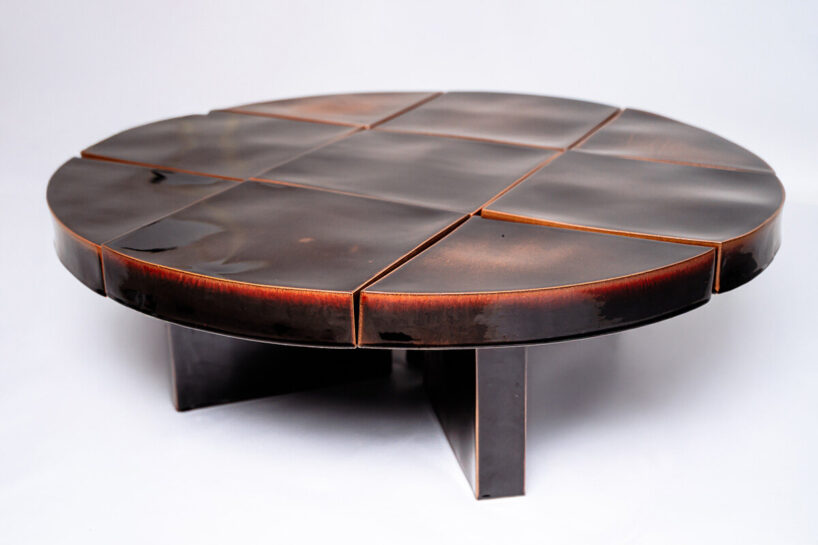
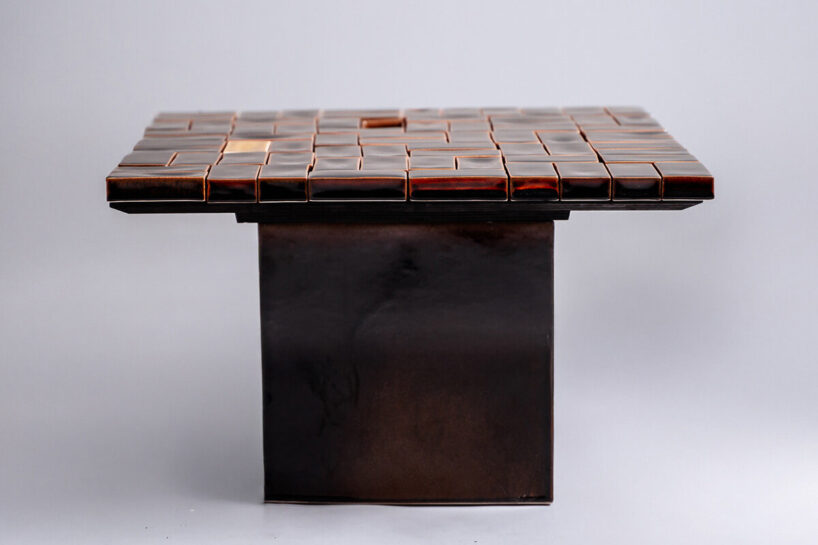
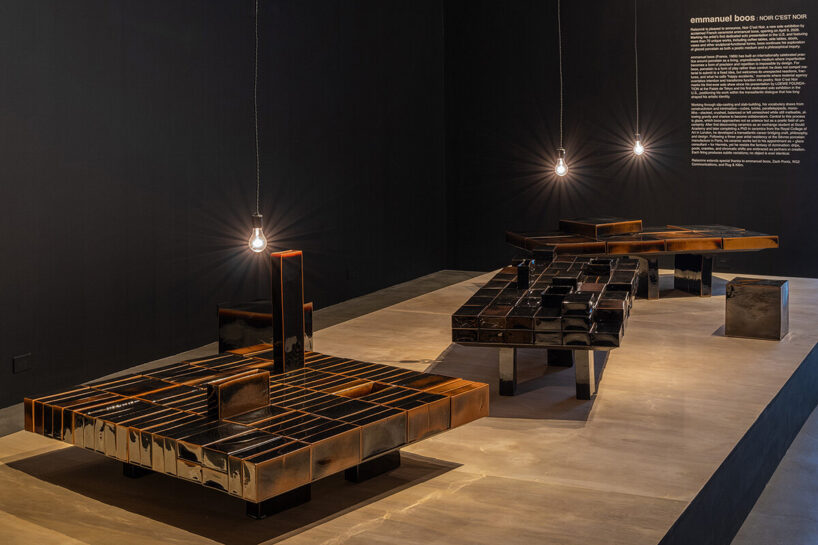
In a way, this mindset can be read through his works on view at Raisonné’. His tables are made from porcelain bricks and modules, their gridded surfaces nearly architectural, but never fully regular. On one hand, the works suggest order. Up close, they reveal small shifts, sags, seams, and warps.

functional ceramic works find beauty in awkwardness
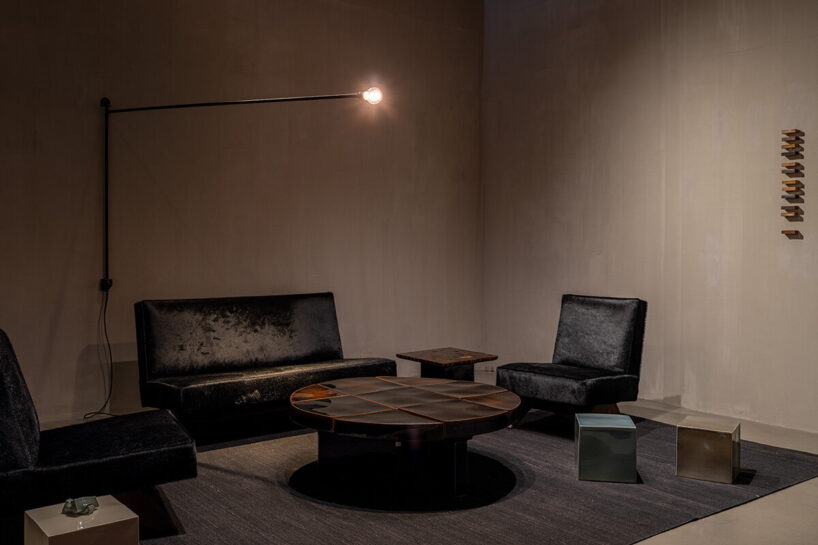
For Noir C’est Noir, Boos developed new works in black and dark brown Tenmoku glazes, alongside celadons and kakis. The exhibition brings together more than seventy unique pieces, including coffee tables, side tables, stools, vases, and sculptural-functional forms.
Many are built from repeated elements: bricks, squares, parallelepipeds, hollow modules that gather into tables or stand as objects in their own right. The pieces remain free and reconfigurable, held in place by balance, weight, and in some cases wooden dowels.

‘That’s the trick,’ he explains. ‘To make them functional enough that you can set them as tables, and then have something in them that questions function and brings them toward something else.’
That slight disturbance of function runs through the show. A table can hold a glass, but it also holds uneven surfaces and inconvenient gaps. A vase can hold flowers, but it may also slump, fold, or lean into another vessel for support. Even still, Boos seems to enjoy the awkwardness. It’s where use stops being automatic and starts becoming a relationship.
the fiction of ceramic perfection
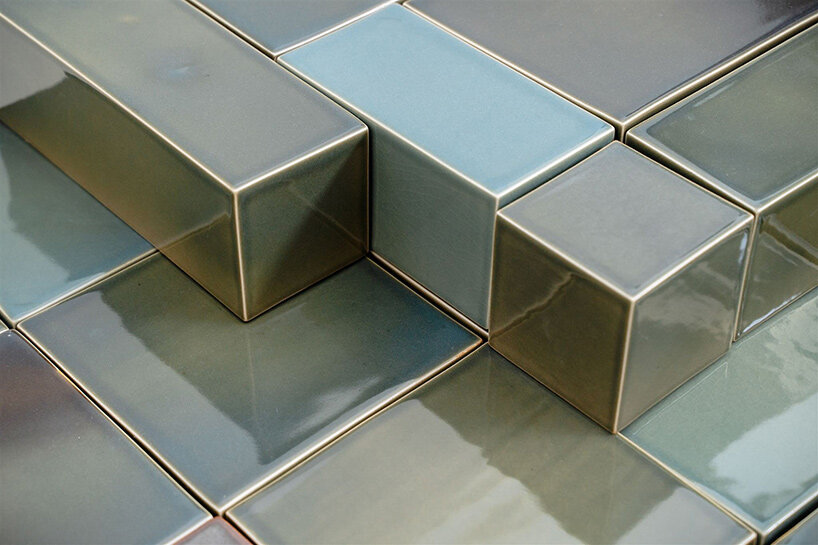
His geometric language sharpens that relationship. Boos uses straight lines and simple volumes because they make the material’s deviations visible.
‘Why do I choose geometric forms?’ he asks while looking at the uneven edges of a table. ‘Because you see the intent was to make something geometrical, but then you see that it didn’t happen. And I think exactly in that difference lives the material.’
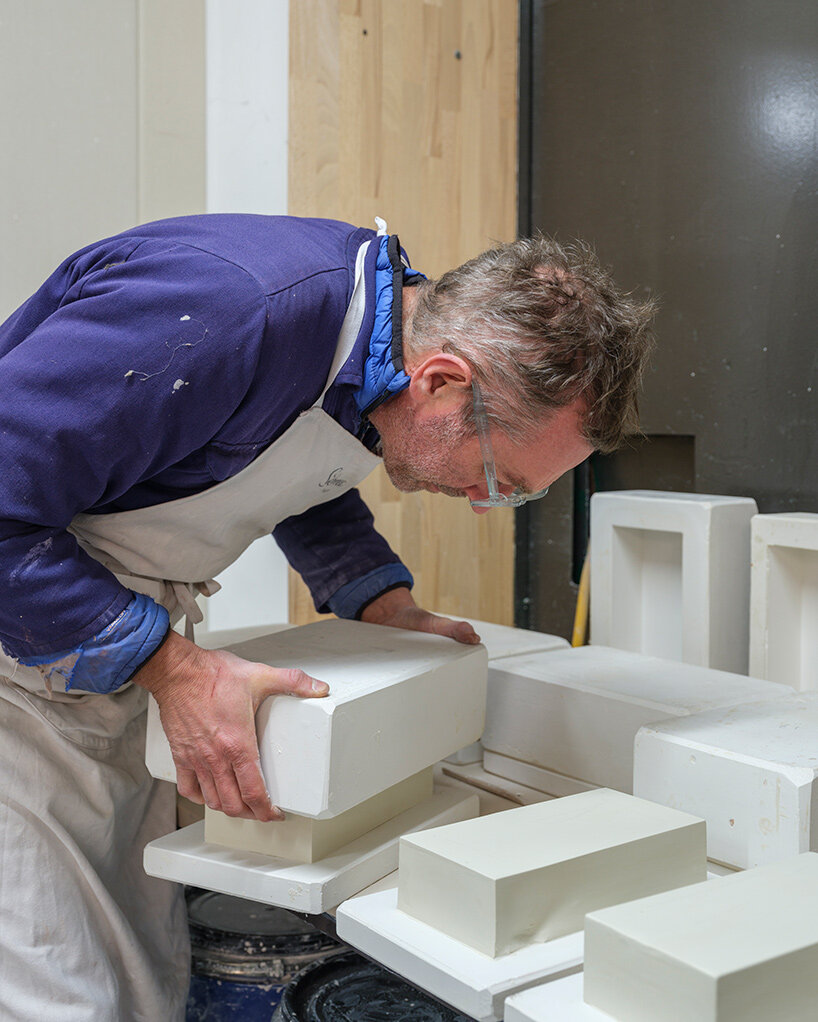
At Sèvres, where Boos completed a residency, he saw the opposite approach: porcelain corrected after firing through long hours of polishing, straightening, and repainting. ‘If a line is bent, they would straighten it by polishing it, and then they’ll paint it,’ he says, describing how this exposes the fiction of ceramic perfection. ‘It’s a facade.’
His own work moves in the other direction, leaving the pressure of making visible over just smoothing it away.
emmanuel boos celebrates cracks and puddles
Glaze complicates the story further. In one table, faint compression lines ripple across the surface, left by the rolling process used to form the slabs. Boos tried to erase them. He polished with a squeegee, then with sandpaper. The lines stayed, almost below the surface.
‘Actually, it’s very beautiful,’ he notes. ‘It looks like the way water moves on sand.’ Nearby, small marks from the glaze gun remain as spots across the surface. ‘I love them. It’s a memory of the process, and then a game.’
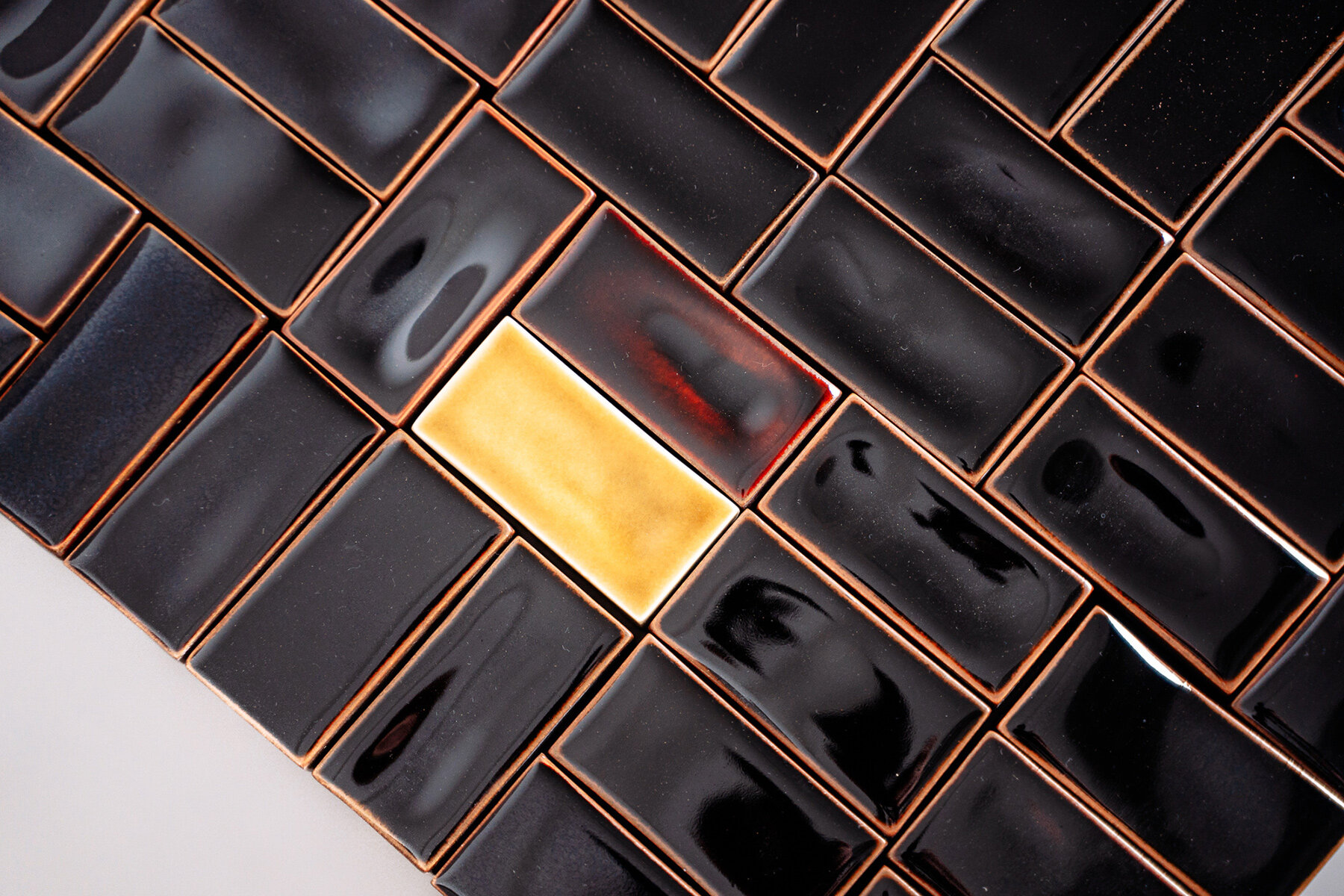
That game depends on deep technical knowledge. Boos is not simply letting accidents happen. He knows how a glaze will run, where it will thin, how a slight height difference will change tone, and when a firing atmosphere will shift color.
‘Only the maker can make such a decision, because it’s informed by process, by practice, and not by the idea of design,’ he says, Pointing to a small indentation designed to catch glaze differently. He is cautious with the word designer. ‘I’m not completely sure I like that,’ he continues, ‘because I think design comes before process. And I am a maker of porcelain and glaze.’
vessels encouraged to slump and kiss
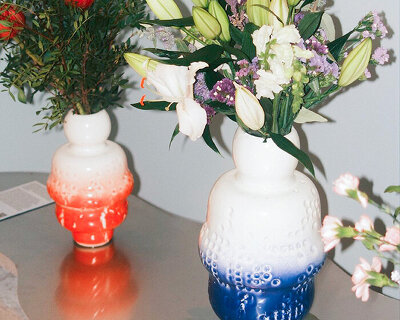
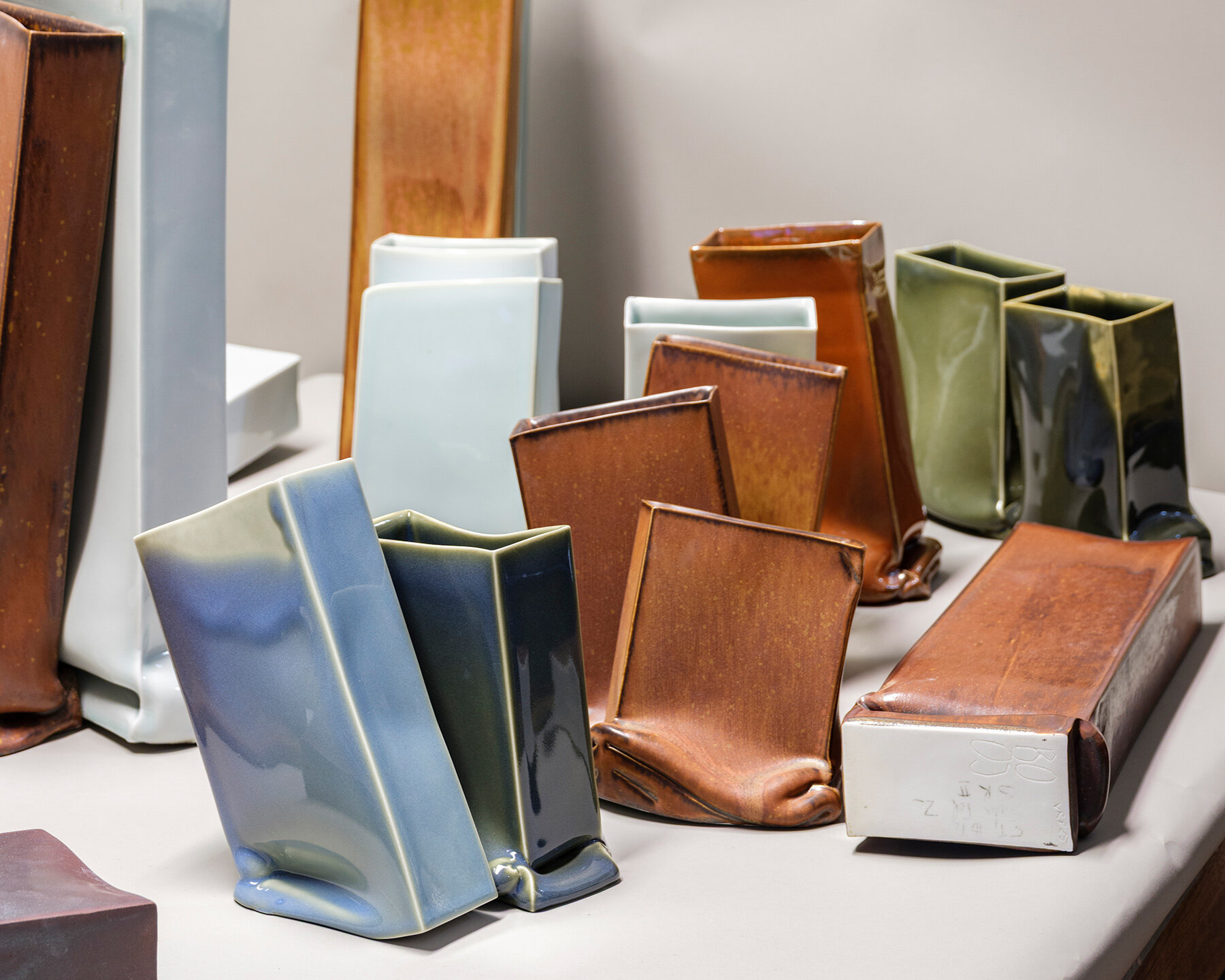
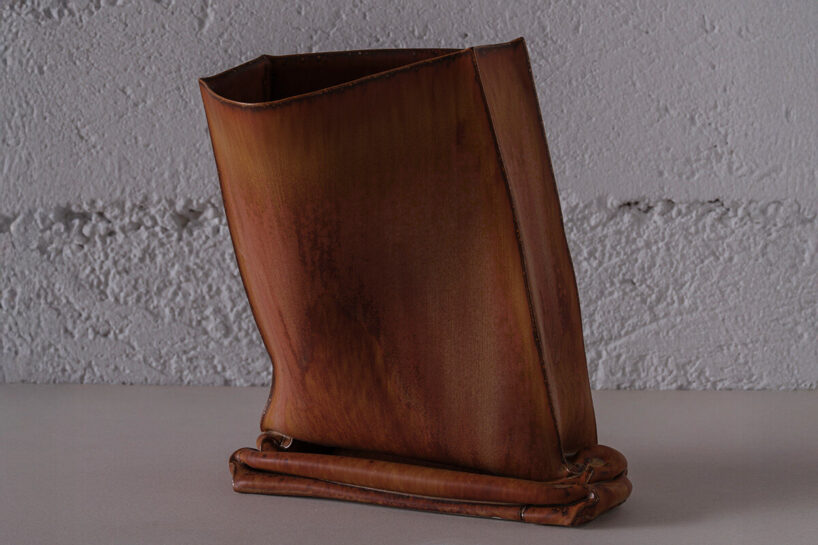
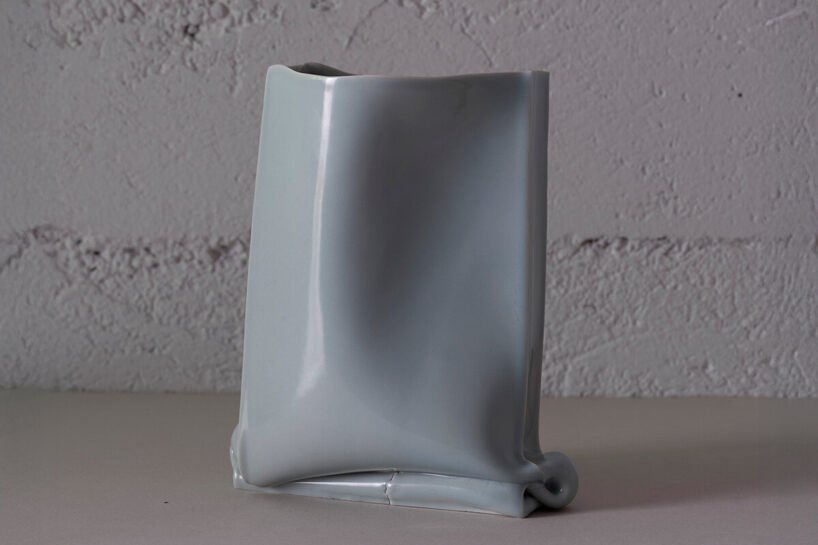
The vessels bring a looser, more physical instability into the room. They began, Boos explains, as a response to a gallery suggestion. He had been focused on ceramic sculptures with bricks and was hesitant to return to something functional, but the idea of a vase eventually opened another path.
‘I struggled at first,’ he admits. ‘And then eventually I said, well, let’s try to open the bricks.’ Some pieces slump dramatically, their rectangular bodies folding inward or leaning to one side. The distortion looks theatrical, but Boos insists on an important distinction: ‘I wouldn’t start fiddling. It’s actually gravity that provokes the deformation. It’s one gesture. It’s rather chance.’
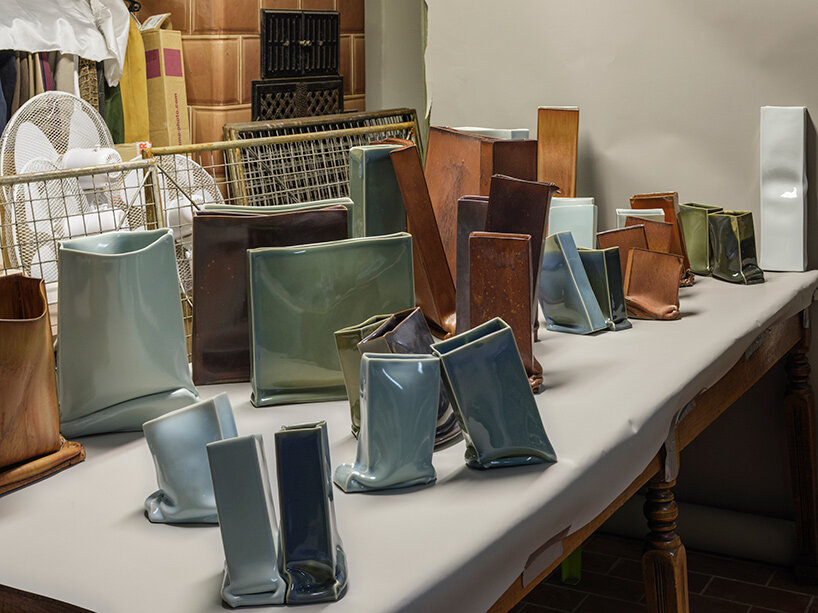
The paired vessels are among the show’s most affecting works. Some leaned into each other in the kiln and fused just enough to survive. ‘There was one piece where they actually stuck, and in doing so they created balance,’ Boos says. ‘They held each other during the whole firing. It was beautiful. I call them lace kisses.’
He describes them almost as relationships, with a tendency to fall apart that becomes the reason they hold together. ‘They’re almost human. Their tendency to fall apart, and in doing so, they actually hold together.’

balancing what the maker wants and what the kiln returns
Across Noir C’est Noir, Boos proposes a kind of making that is technical without becoming rigid, playful without becoming casual. He knows the history of his glazes, the behavior of his porcelain, and the pressures of firing at high temperature, but he also leaves room for the object to answer back.
‘My practice of glaze does not aim for mastery nor domination. I wish to slip into the glaze and develop a friendly relationship with chaos and eventually trust chance. It is emotion, sensuality, poetry.’
For those emerging creators, Boos offers a word of advice: ‘You’re constantly let down,’ he says, describing the gap between what the maker wants and what the kiln returns. But for him, disappointment is only the first step.
‘I overcome the feeling of deception and start playing,’ he goes on. ‘I say, okay, well, you’re saying I can’t do that. You’re giving me this. So what if I do this?’
It is in that second move, after control fails, that the work begins to feel most alive.

1/7
project info:
exhibition: Noir C’est Noir
artist: ceramicist | @emmanuel_boos_
gallery: gallery | @raisonne.nyc
opening date: April 9th, 2026
photography: © Zach Pontz | @zachpontz
This article is part of designboom’s Crafting the Future chapter, exploring what it means to be a maker in today’s world and the future of craftsmanship. Discover more related stories here.
shop
your own online design shop — no sales commission collected