immaterialize by rhode island school of design
risd / Rhode Island School of Design’s contribution to this year’s ICFF showcases furniture and products that emphasize specific qualities of materials rather than their most familiar applications.
prefer designboom on google[FEATURED]
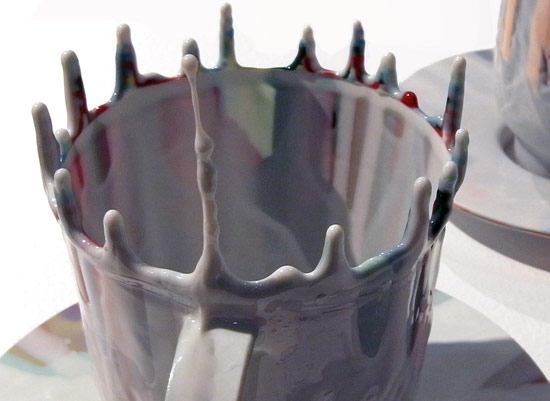
‘pour’ cup and saucer by elisa werbler image © designboom
 elisa werbler portrait © designboom‘pour’ is a series of teacups and saucers made entirely of molded liquid plastic by elisa werbler (BFA 2009). the forms were created through a succession of pours against a mold, each one using a different color to create not only an organic dripping effect but a clean, layered cross-section as well. contrast is central to the pieces: the free-form drips play against the neat cross-section, and the glossy surface of the exterior contrasts with the matte interior.
 ‘pour’ cup and saucer by elisa werbler image © designboom
 ‘perch’ feather and ceramic bowl by andrew mau image © designboom
 ‘perch’ feather and ceramic bowl by andrew mau image © designboomafter researching the use of feathers in decorative arts, andrew mau (BFA 2009) created a breathtaking bowl called perch, an unglazed porcelain piece that stands on a base of quills and supports an intricate array of tightly layered, beautifully colored pheasant feathers lining the interior. each heart-shaped feather is precisely trimmed to provide a consistent natural color and to emphasize the contrasting interior and exterior textures.
 andrew mau portrait © designboom
 loofah ankle boot by ian horowitz image © designboom
in ‘loofah ankle boot’, ian horowitz (BFA 2009) explores applications of non-manufactured fabrics in footwear, demonstrating that luxury and environmental consciousness can go hand in hand. for the ankle boot, two-ply construction with quilted reinforcement throughout the upper ensures durability, with each shoe constructed of dried vegetables and a small block of poplar wood.
 ian horowitz portrait © designboom
 ‘supple’ zipper bowl in bubble wrap and silicone by chelsea frost image © designboom
in supple, chelsea frost(BFA 2009) transformed everyday packing material into a surprisingly appealing set of household pillows by making multiple silicone rubber castings of bubble wrap and attaching zippers to provide support. the zippers also allow the pillows to be packed flat and then assembled into their 3D form on arrival.
 ‘supple’ zipper bowl in bubble wrap and silicone by chelsea frost
 ‘split’ leather seat by isao takezawa image © designboom
the split seat by isao takezawa(BFA 2009) is made of vegetable-tanned leather, which gains structural integrity when soaked in boiling water and dried. the stool is composed of three identical pieces that were sewn together after the hardening process, with the rigidity striking the ideal balance between comfort and sturdiness; the combination of a traditional technique and a contemporary design approach opens up new possibilities for the material.
 ‘100 % wax’ white wax stool by debra folz image © designboom
debra folze (MFA 2010) created a sturdy, fully functional table, fittingly called 100% wax, first by casting industrial wax, and then pouring liquid wax over a bed of wax still in bead form to create a textured surface.
 ‘flow’ chair by jennifer tran image © designboom
made of a minimum of 40% post-industrial recycled material, the flow chair by jennifer tran (BFA 2009) evolved from trial-and-error when heating 3form’s Varia Ecoresin to a malleable state and then quickly forming it by hand. evenly spaced grooves provide a bold, graphic contrast to the undulating, organic shape of the chair.
 jennifer tran portrait © designboom
 ‘out of skin’ stool by micaelan davis ‘crochet crochet’ metal seat by ruth fore image © designboom
in ‘of the skin‘, micaelan davis (MFA 2009) went beyond the typical application for rawhide to fold and mold water-soaked buffalo hide into a sturdy, beautifully organic table with a warm, amber glow.
 ‘out of skin’ stool by micaelan davis
 ‘crochet crochet’ metal seat by ruth fore image © designboominspired by the idea of making a stable structure using a process known for its softness and flexibility, ruth fore (MFA 2009) experimented with crochet stitches to create ‘crochet crochet’, a spherical wire form, with loops growing from small to large gauges. roughly 3,000 feet of aluminum wire went into the finished piece, which was then anodized to improve its strength and stability.
 rosanne somerson, professor risd at the risd booth image © designboom
risd / rhode island school of design exhibited during the new york design week in the ICFF show floor.
shop
your own online design shop — no sales commission collected