jean-baptiste fastrez turns an inflatable boat and a wall fixing into mirrors to look and to be looked at
'I like the paradox of an object that has such a strong physical presence, yet whose image is almost entirely made up of whatever surrounds it,' says the french designer, who has spent more than a decade of his practice reworking the mirror through different forms and materials.
prefer designboom on google[FEATURED]
The mirror as an object to look and to be looked at
‘The mirror is, after all, a utopia, since it is a placeless place,’ said Michel Foucault in a 1967 lecture, explaining that in a mirror you see yourself where you are not, ‘in an unreal, virtual space that opens up behind the surface.’ He then called it a heterotopia as well, since the mirror does exist in reality, where it ‘exerts a sort of counteraction’ on the position you occupy. No other object in a house behaves this way, since everything else in a room is looked at while a mirror hands the room back with its viewer inside it. That duality, between what the object looks like and what it does to whoever stands in front of it, has given the mirror an unusual position in design. Creatives have worked on both halves of it, the form and the surface, which is why the object keeps producing experiments in both how it looks and how we see.
In Jean-Baptiste Fastrez’s case, the mirror is ‘one of the objects that offers the greatest freedom to explore ideas somewhere between design and sculpture.’ The French designer, who has spent more than a decade of his practice reworking this one object through different forms and materials, tells designboom that he likes the paradox ‘of an object that has such a strong physical presence, yet whose image is almost entirely made up of whatever surrounds it.’ Two of his recent designs for Paris-based design company Moustache push that paradox in two very different directions.
Jean-Baptiste Fastrez’s sculptural mirrors for Moustache
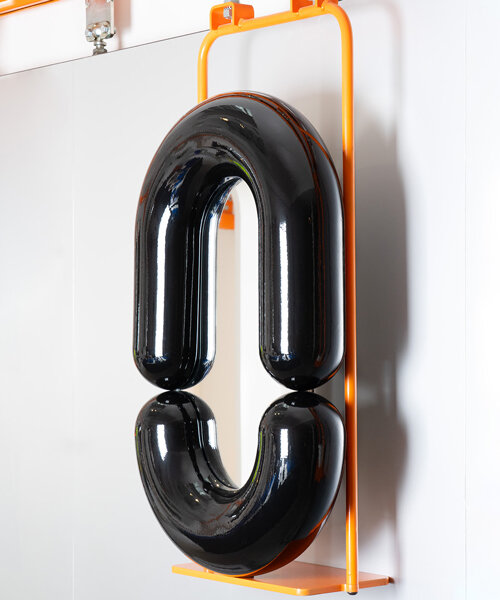
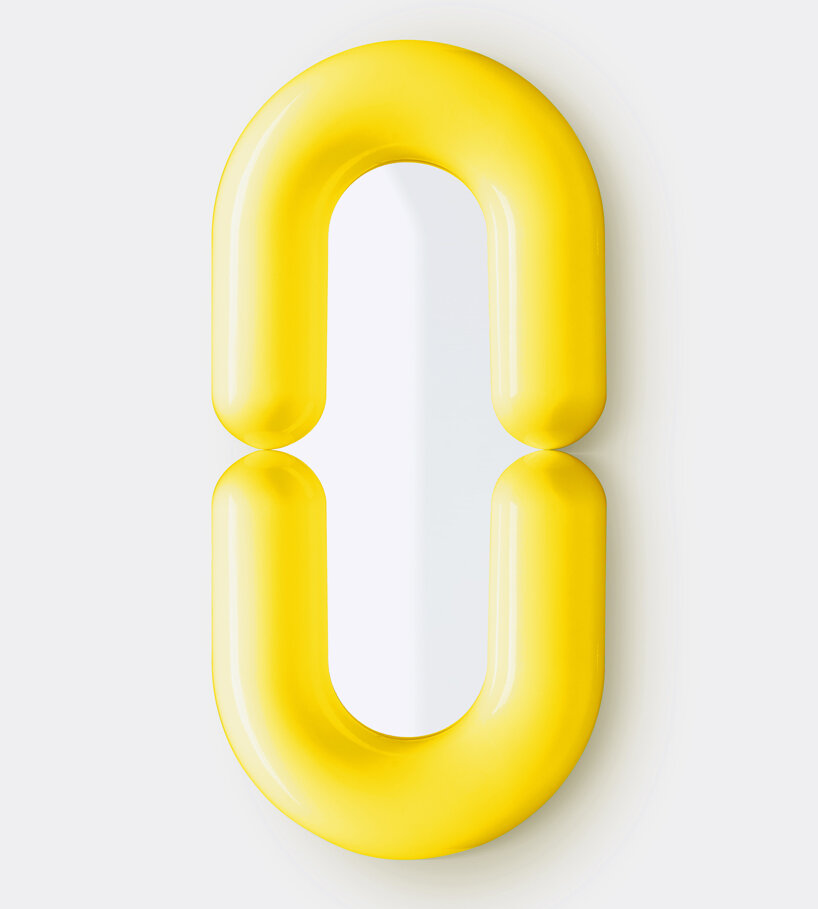
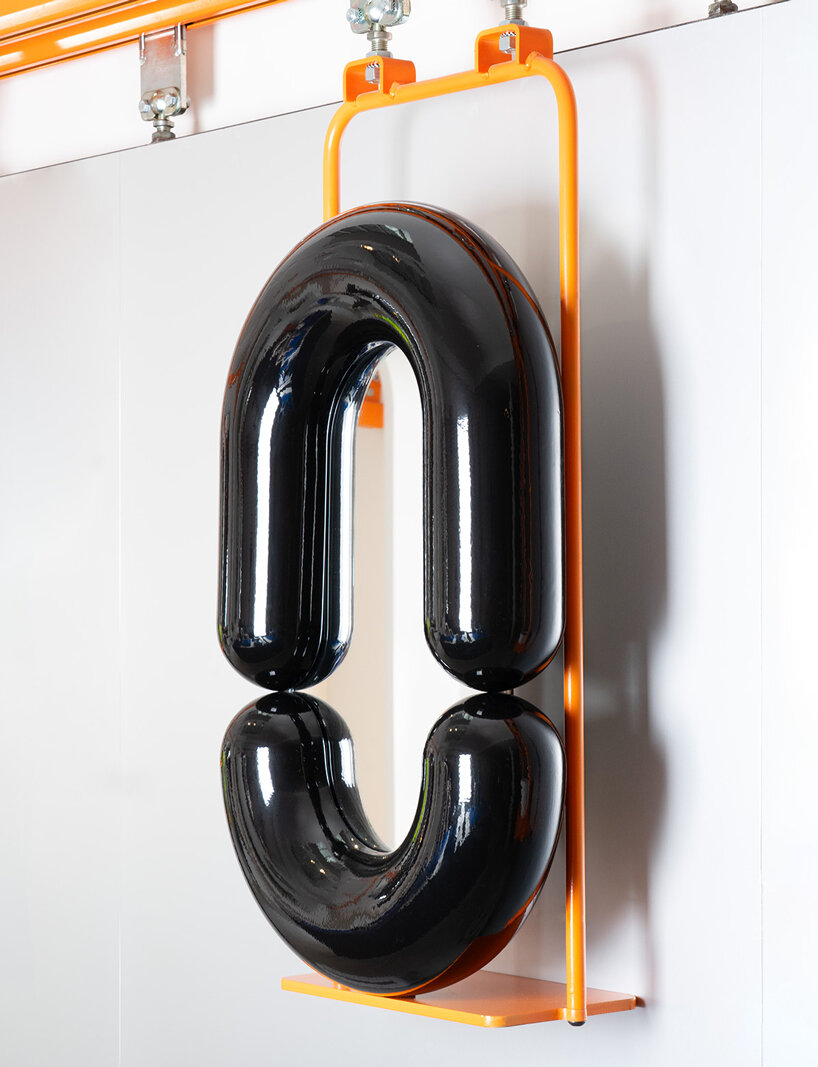
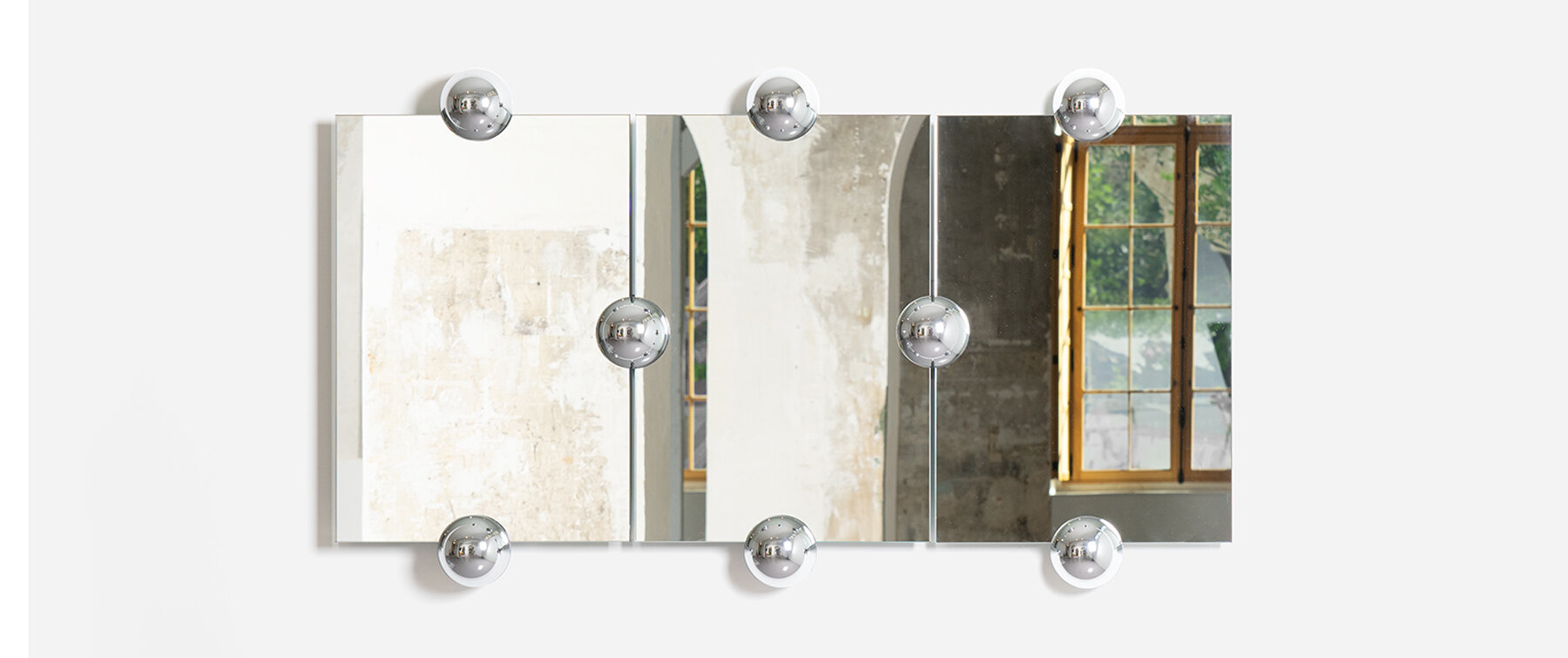
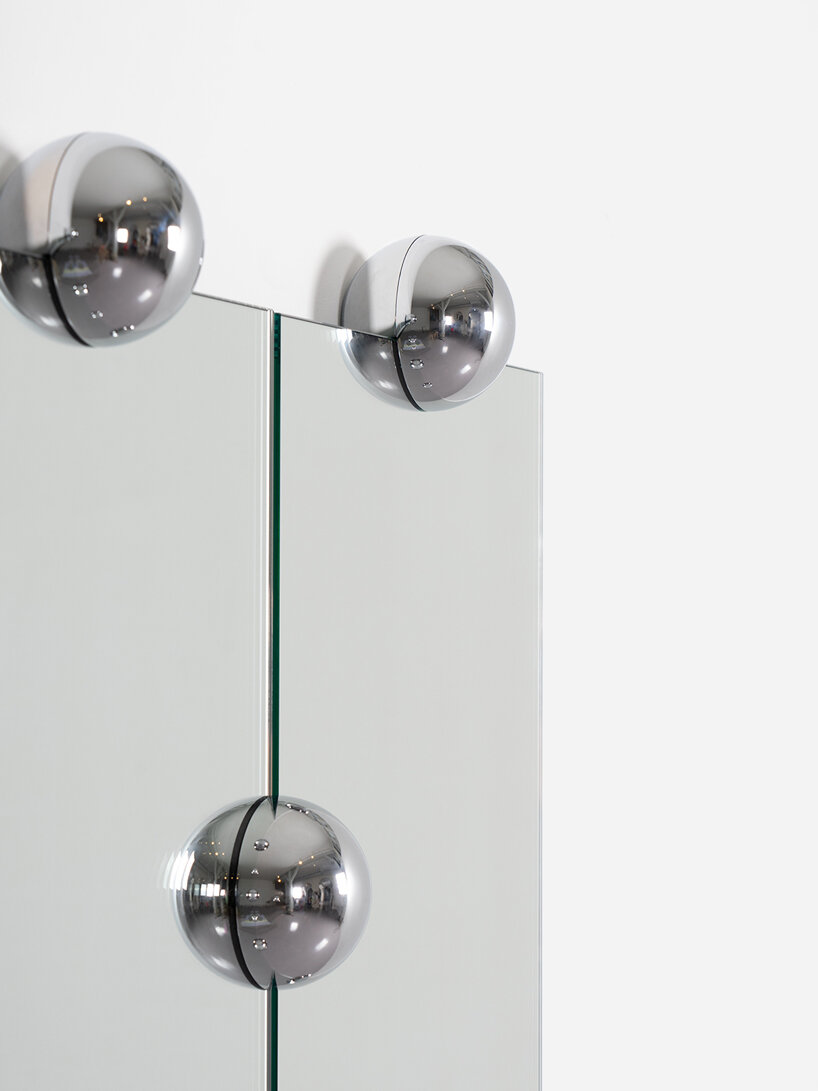
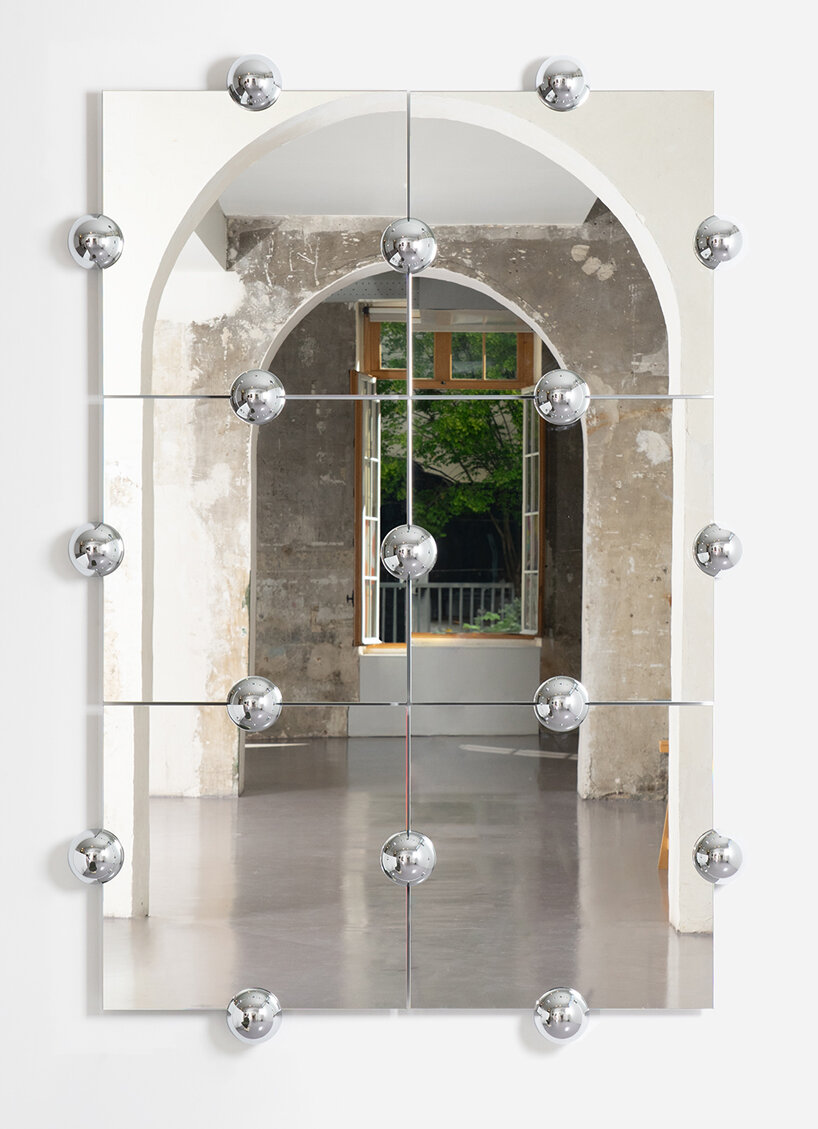
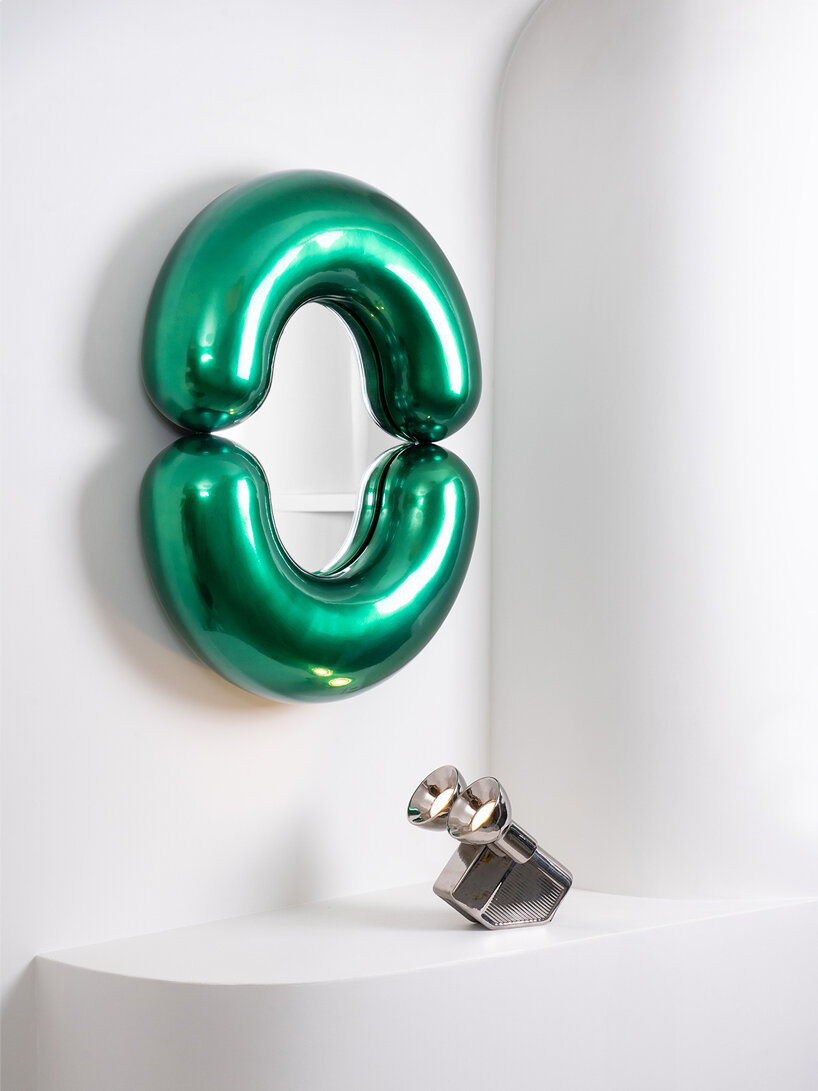
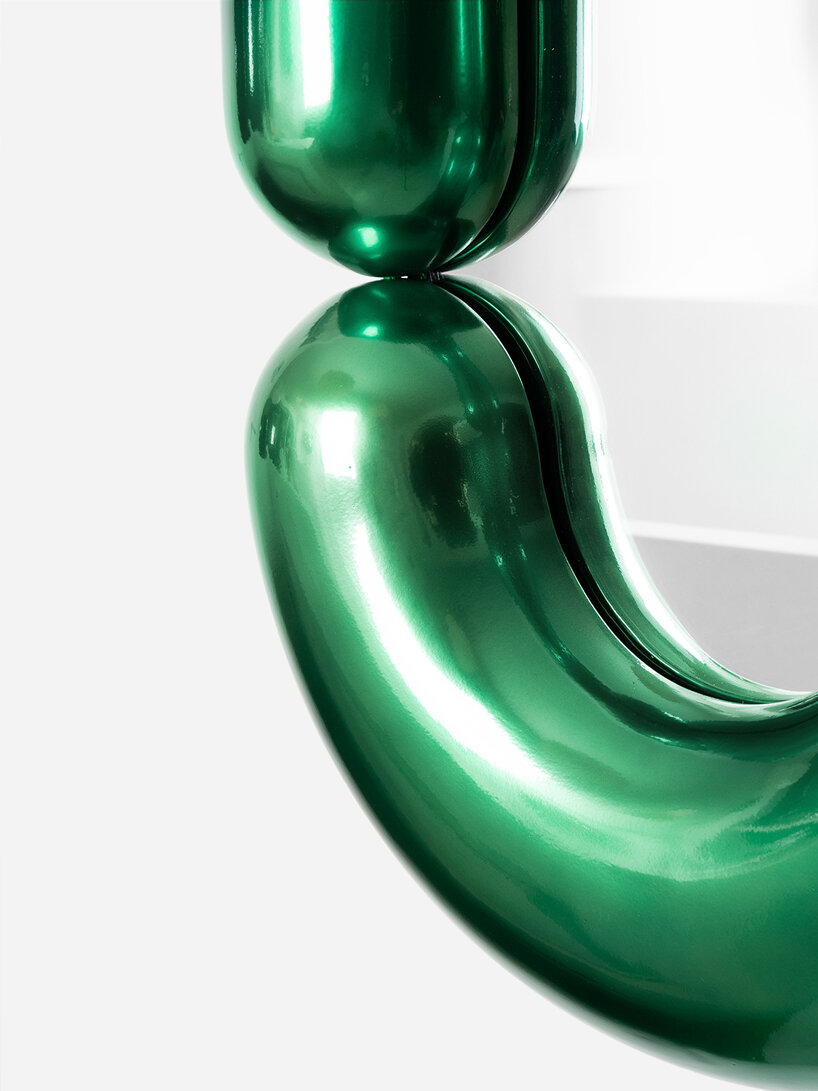
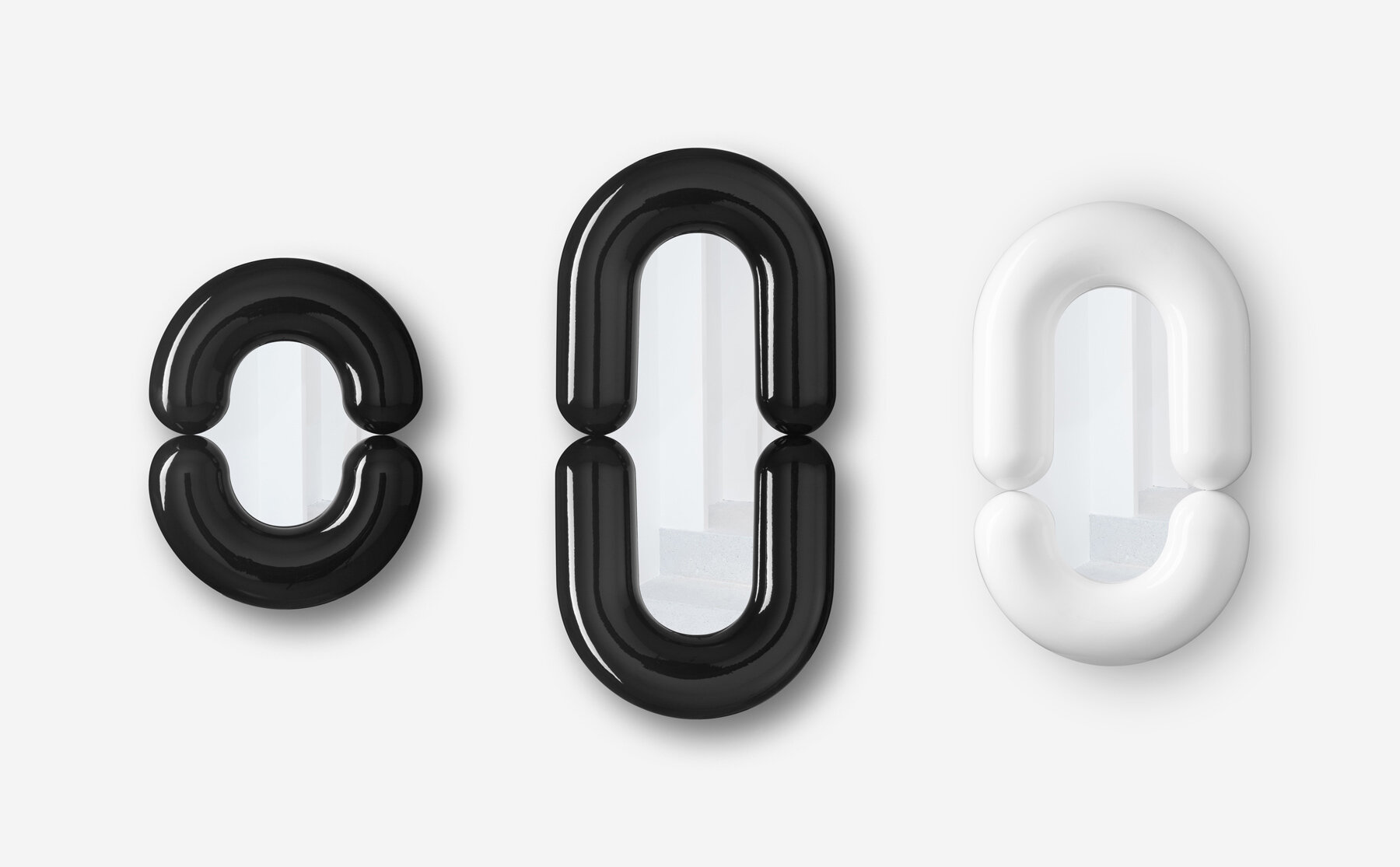
Both pieces Fastrez developed for Moustache begin from something that already exists. The Zodiac mirror borrows its form from the inflatable boat it is named after, so that what looks like an inflated tube is in fact high-gloss ceramic. Sphera, on the other hand, takes its cues from the hardware once used to hold mirrored walls together, reworking it into a set of oversized chrome spheres that clamp sheets of flat mirror to a wall.
‘With Zodiac, I was interested in the idea of the ready-made, or rather the fake ready-made,’ he says. ‘I wanted to create objects that looked as though they had been made by repurposing something else.’ The image was precise from the start, an inflatable boat whose inflated tube becomes a sort of floating frame, and the story he wanted was of a boat that had somehow ended up hanging on a wall and turned into a mirror. ‘I really enjoy these collisions between completely different types of objects,’ he says. ‘They can create narratives that are both strong and open-ended, with something almost mysterious about them.’
The idea for Sphera arrived in a particular room. ‘I remember very clearly that the idea came to me while visiting Carlo Mollino’s house in Turin,’ Fastrez says. ‘Some of the walls in his preserved apartment are covered with mirrors made up of several sections, held together by small chrome fittings. I found this fascinating, before realising that the system was actually nothing particularly unusual.’ The fitting was not a Mollino invention and was never rare, and he is precise about where it lived, ‘quite common throughout the twentieth century, in sophisticated architectural interiors as well as much more ordinary settings, like a bathroom or a student bedroom.’
What he saw in it was a frame with no shape of its own. ‘I started to see it as perhaps the most minimal frame imaginable, but also one of the most universal,’ he says. ‘It allows an enormous variety of formats, compositions and uses.’ His decision was then not to redesign the principle but to change its volume. ‘I wanted to take this principle almost exactly as it was, but give these little fixing elements a much stronger presence. I increased their size and transformed their geometry into something spherical, almost sculptural.’
THE GLASS AS STRUCTURE RATHER THAN AS SURFACE in ZODIAC & SPHERA
What makes a mirror worth more than a decade of a designer’s attention is how little it asks. ‘A mirror is an object whose function is reduced to its absolute minimum,’ Fastrez says. ‘As long as something has a reflective surface, it can essentially be considered a mirror.’ Hung on a wall it carries nobody’s weight and resists nothing, so it never faces the structural tests a chair or a table has to pass, and what remains is a single geometric demand, which is that it stay more or less flat.
He treats that as a paradox rather than a gift, one severe constraint in a single direction and almost total freedom in every other, and says constraints are what he finds stimulating in the first place. By his own account it is probably the object that leaves him the most room to work somewhere between design and sculpture, and the one most willing to carry a story.
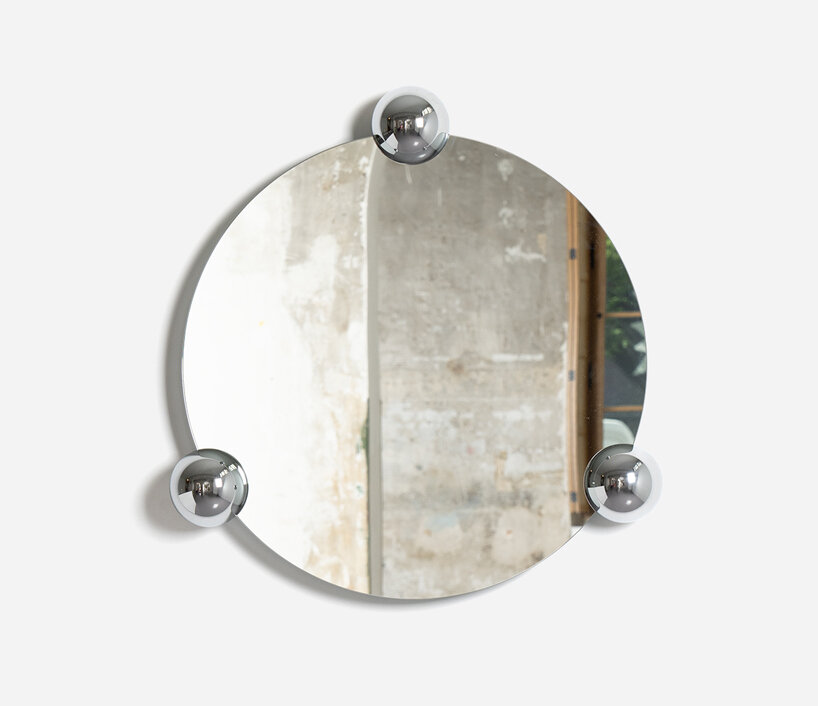
Both of these pieces then do something that reverses what a mirror usually is, which is to use the glass as structure rather than as surface. Zodiac’s ceramic frame is half a ring, built from two moulded sections, and where the ceramic stops the reflection continues, so what the eye reads as two inflated tubes floating one above the other is a single tube and its image. ‘The reflection becomes an essential part of the object’s construction,’ Fastrez says, and in doing that work the mirror very nearly disappears. Sphera relies on the glass just as literally, since without the rigidity of a sheet of mirror the fixing system has nothing to hold and nothing to hold it. ‘With Sphera, the object is visually made of nothing but chrome and reflections,’ he says. ‘Its appearance depends entirely on its surroundings, which are reflected faithfully in the flat mirror and distorted across the chrome spheres.’
ORNAMENT AS FUNCTION IN ITS OWN RIGHT
‘I’m very interested in the idea of taking something as ordinary as a piece of hardware and reworking it until it becomes the strongest aesthetic feature of a project,’ Fastrez says. Both pieces end as arguments about ornament, and he makes the argument himself rather than leaving it to be inferred. ‘Ornament is something I actively pursue in my work as a designer, but I find it particularly interesting when it isn’t simply added to an object, but becomes part of its construction or the way it functions,’ he explains, and he describes that as possibly the most interesting form design can take, an object acquiring a sculptural character directly out of the logic that produced it. Sphera, by his account, began at the moment he realized that emphasising the small functional elements would generate ornament without costing the original system any of its functionalism.
The second half of the argument is about the word function itself. ‘I also think our definition of an object’s function is often far too restrictive,’ he notes. ‘An object never serves just one purpose. A mirror’s primary function might seem to be reflecting an image, but to me that’s a very incomplete definition. A mirror also serves to decorate an interior, to give it character, to place a space within a particular period, style or narrative.’ He then goes further than most designers would be willing to, and says that this ornamental function can be as important as the reflective one and is sometimes more so.
That produces a reversal of the sentence design students have been handed since Louis Sullivan wrote it in 1896, and of the century of suspicion toward ornament that followed. ‘If we accept ornament as a function in its own right,’ Fastrez says, ‘Zodiac and Sphera are, in their own way, functionalist objects whose form also follows their ornamental function.’ Zodiac arrives there through the relationship between a frame and its reflection, Sphera through the repetition of a fitting that spent fifty years being hidden, and in both cases the decoration is not sitting on the object but holding it up.
project info:
name: Zodiac and Sphera
designer: Jean-Baptiste Fastrez | @jeanbaptistefastrez
company: Moustache | @moustache_editions
This article is part of designboom’s SPECTATOR AND SPECTACLE chapter, asking how wonder gets built, and how it might return some mystery to a world that has measured most of it away. Presented in partnership with SolidNature, the stories in this chapter turn onlookers into participants, alter perception and disrupt the everyday – learn more here!
Each designboom chapter explores one theme in depth through projects, interviews, features and news across architecture, design, art and technology. Discover more chapters here, and get in touch if you’d like to submit a story through our submissions portal or contact form.
shop
your own online design shop — no sales commission collected