
NIKO JUNE lets industrial fragments bloom into a bouquet of collectible objects
'bouquet theory' transforms forgotten moulds, scrap steel, and industrial leftovers into a family of cast glass, wood, and aluminium objects.
NIKO JUNE REASSEMBLES INDUSTRIAL REMNANTS INTO FAMILY OF OBJECTS
At the Copenhagen group show Other Circle during 3daysofdesign, Danish studio NIKO JUNE presents Bouquet Theory, an exhibition of cast glass tables, carved wooden stools, drinking glasses, and sculptural objects assembled from found industrial fragments, obsolete molds, steel profiles, and discarded manufacturing components. The project preserves the histories of these materials, allowing their industrial past to shine within each piece and exploring how overlooked materials can be rearranged into functional objects through craft and experimentation.
The collection brings together discarded industrial components that would otherwise be overlooked, giving them new roles as structural and decorative elements. NIKO JUNE allows the characteristics of each fragment to influence the final object, producing a collection that is unified through gesture.
‘When we work with materials, we generally like to experiment and explore their possibilities,’ Johannes Timo of NIKO JUNE shares with designboom. ‘With glass in particular, we often try to push its limitations. It’s such a fun and exciting material to work with, and the process is always full of discoveries.’

CAST GLASS PRESERVES THE MEMORY OF INDUSTRIAL OBJECTS
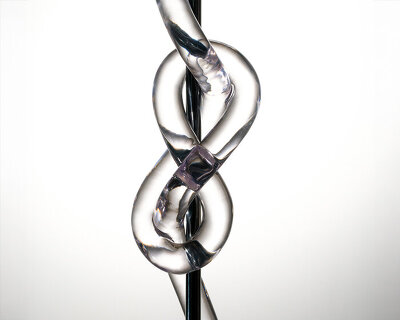
Throughout the collection, the designers at NIKO JUNE embed fragments of obsolete molds, steel components, and discarded industrial parts within transparent cast glass, preserving traces of previous manufacturing processes while giving them entirely new functions. The material magnifies these inclusions, allowing forgotten objects to remain visible inside the finished pieces.
Producing each of the large cast glass tables featured in the exhibition required pouring molten glass seven or eight separate times to achieve the necessary volume. The molds were fabricated from bent scrap metal elements assembled into oversized cookie-cutter-like profiles, turning industrial leftovers into temporary tools for creating new forms.
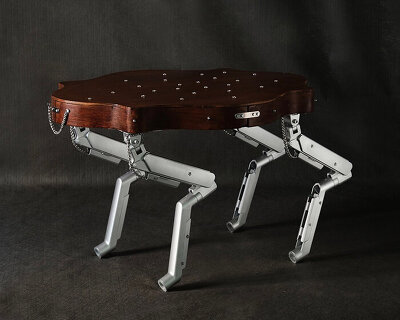
The glass tops rest on aluminum bases engineered with flexible feet that allow the four-legged structure to self-level on uneven surfaces. The mechanism introduces a subtle movement, giving the tables the gentle motion of flowers swaying in the wind. The casting process becomes part of the design, with the multiple pours, reused molds, and embedded fragments all remaining legible in the finished objects.

HAND CARVING EMBRACES VARIATION OVER STANDARDIZATION
NIKO JUNE also presents a series of six solid wooden stools carved directly from tree trunks alongside the glass works. Using chainsaws, angle grinders, and sanding tools, the studio removes material through a direct process that allows the logs to dictate their distinct proportions and character.
Although they belong to the same series, each stool differs according to the grain, irregularities, and decisions made during carving. The exhibition positions these handcrafted objects alongside cast glass works without privileging one material over another, both demonstrating an interest in allowing process, material behavior, and chance to shape the final outcome.

CRAFT AS A PROCESS OF DISCOVERY
While Bouquet Theory draws upon readymade objects and industrial remnants, it is less concerned with recycling as an end in itself than with discovering new possibilities through making. Scrap metal becomes molds; obsolete steel components become ornaments. Manufacturing leftovers are transformed into structural details preserved permanently inside glass.
Like a bouquet assembled from distinct stems, each object maintains its own identity, contributing to a larger composition built through contrast and repetition. The works form a family connected by relationships between materials and methods of assembly.
Bouquet Theory treats industrial waste as a starting point for experimentation. NIKO JUNE demonstrates how contemporary craft can emerge through curiosity, improvisation, and a willingness to push familiar materials beyond their expected uses.
‘I think you can see that we had a lot of fun making these pieces,’ Johannes Timo tells us.


project info:
name: Bouquet Theory
studio: NIKO JUNE | @niko__june
founder: Johannes Timo
venue: Other Circle
location: Copenhagen, Denmark
This article is part of designboom’s Crafting the Future chapter, exploring what it means to be a maker in today’s world and the future of craftsmanship. Discover more related stories here.
shop
your own online design shop — no sales commission collected