the stillness of sri lankan temples translates into handcrafted ceramic lighting
integrated openings reveal the lighting objects’ carefully considered details.
prefer designboom on googleSri Lankan architecture inspires the Temple Lighting Collection
The architecture of Sri Lankan temples and the ascent of Adam’s Peak inform the Temple lighting collection by Bouti Studio, a series of architectural ceramic lighting objects defined by geometric forms, integrated openings, and a restrained material language.
At Adam’s Peak in Sri Lanka, approximately 5,000 steps lead to a summit where visitors from different backgrounds gather to watch the sunrise. The ascent culminates at a large bell that visitors ring upon reaching the top. The sequence of climbing, gathering, and quiet observation provides the conceptual starting point for Temple, designed by Clément Boutillon. Rather than reproducing these references literally, the collection translates their spatial and atmospheric qualities into a series of minimal lighting objects. Each piece is defined by a simple architectural volume and a limited number of carefully positioned details. From a distance, the forms appear as compact geometric objects; closer views reveal openings, tapered profiles, and transitions between surfaces.

Three Lighting Objects, One Formal Language by Bouti Studio
The collection by Bouti Studio comprises three lighting typologies developed through a shared formal language. Geometric volumes are adapted to different uses, with specific openings and structural details integrated into each design.
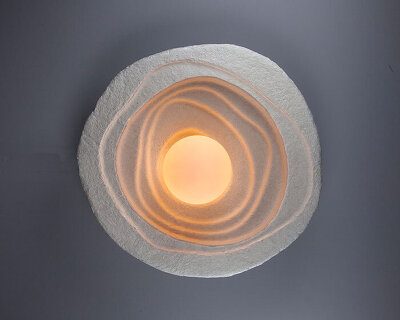
The table lamp is the most substantial piece in the collection, functioning as a sculptural object with a grounded form. Four openings distribute light across its walls while revealing the organic details of the ceramic body. The wall light is also available as a pendant and portable lamp. Its form suggests a rotational geometry without being fully symmetrical, with contrasting profiles creating an optical illusion. Two openings direct light upward and downward, while two additional openings are concealed at the rear, visually lifting the volume from the wall. The portable lamp is suspended from a wooden peg and can also function as a wall light. Its height can be adjusted according to the desired lighting effect, from a higher position that produces a softer general glow to a lower placement that creates a more pronounced decorative presence. Solid-brass fixings and a satin braided cable remain visible as part of the design.

Clément Boutillon Bridges Digital Modeling and Ceramic Craft
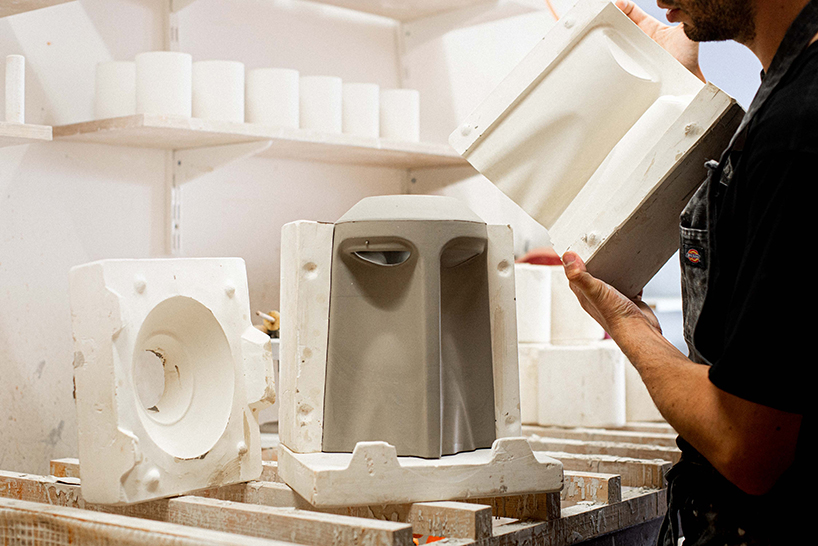
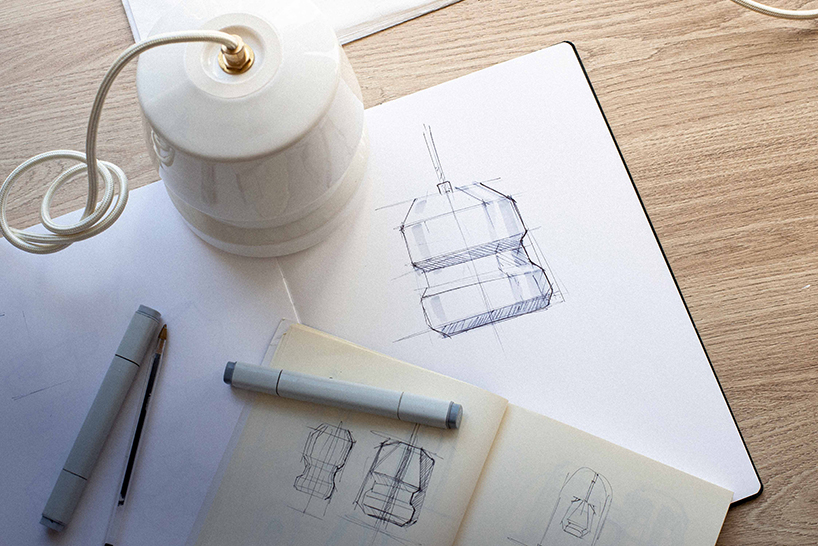
Each piece begins with a combination of hand drawing and digital modeling. The form is first sketched before being developed three-dimensionally, allowing its aesthetic and functional properties to be refined through the design process. The resulting digital model is 3D printed and used to create a plaster mold. Liquid faience is then poured into the mold, capturing the geometry of the form. Once the mold is removed, the raw clay is cut and finished by hand.
The pieces undergo an initial firing at 1,020°C before receiving a white glaze. A second firing at 1,040°C establishes the final surface finish. The collection is produced in France, with each piece shaped by hand in Bouti Studio’s workshop, and is available to private clients and interior designers.



project info:
name: Temple lighting collection
designer: Bouti Studio – Clément Boutillon | @boutistudio
designboom has received this project from our DIY submissions feature, where we welcome our readers to submit their own work for publication. See more project submissions from our readers here.
shop
your own online design shop — no sales commission collected