studio LONK explores the future of shared living spaces at dutch design week 2019
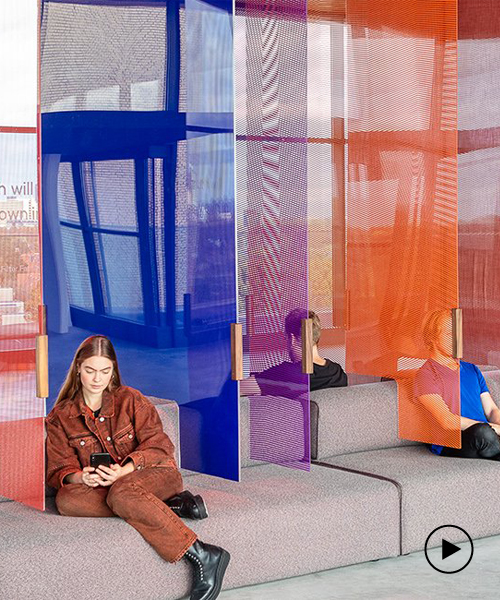
by pushing and pulling the panels, visitors can expand or reduce their territory and find a balance between privacy and social interaction.
prefer designboom on google[FEATURED]
beginning with the question, ‘how will we live in the future?’, studio LONK has investigated the idea of shared living spaces during 2019’s edition of dutch design week in eindhoven. to explore the concept, the designers teamed up with furniture brand leolux to create ‘filter family’ – an interactive installation that consists of one enormous sofa and 14 moveable, colored panels.

‘filter family’ is an interactive installation that consists of an enormous leolux sofa and 14 pendant, moveable panels
all images © zebra fotostudio’s
‘filter family’ imagines the landscape of our living environments in the year 2030. on display during DDW 2019, the installation invited thousands of visitors to interact with the piece. using the sliding panels to delineate space, the design team ultimately asked users to think about their future home and consider: how much personal space do I need? what am I willing to share? and how will I find a balance between privacy and social interaction?
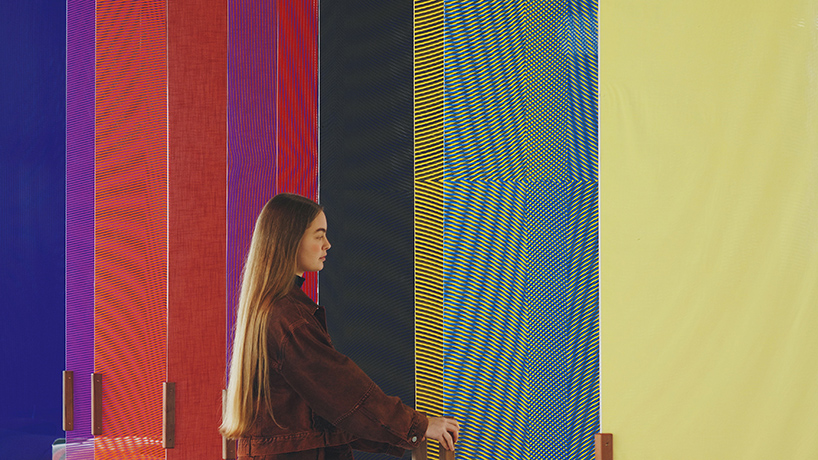
‘filter family’ is all about continuous adaptation
by pushing and pulling plexiglass panels on an enormous sofa, visitors can expand or reduce their territory and find a balance between privacy and social interaction. anna dekker, sociologist at studio LONK explains: ‘the sofa is clearly too large for any individual household and communicates that it’s a space to be shared. we wanted visitors to become aware of the impact of their territorial decisions. the more personal space you occupy, the less is left for others.’
video © JHB visuals
the design team envision that in 2030, relationships and households will be increasingly ‘liquid’ and the border between the physical and virtual world will be more blurred, just like the difference between real and fake. celine de waal malefijt, spatial designer at studio LONK comments: ‘with the sofa as the only static object, this work is all about continuous adaptation. we designed the layering of panels to create a moiré effect. the resulting patterns appear to be in motion, and represent the liquid and digital quality of social relationships in the future. the person next to you is filtered away and seems to appear ‘on screen’.’

to each his own: the fluid composition of a shared environment
the installation is the result of ‘what if lab’, an initiative of the dutch design foundation and leolux. hans filippini, leolux marketing director says: ‘as a furniture brand we usually ask designers to develop the sofa of next year or the year thereafter. this time, we enjoyed to be challenged to look further ahead. we were not looking for a concrete furniture design but rather an independent and creative view into a possible future. we selected studio LONK because of the thought-provoking, interactive and intuitive quality of the installation. rather than answering the ‘what if lab’ question, ‘filter family’ stirs up additional reflection, both among our clients and within our company.’

switching between digital intimacy and social gatherings in a shared living space
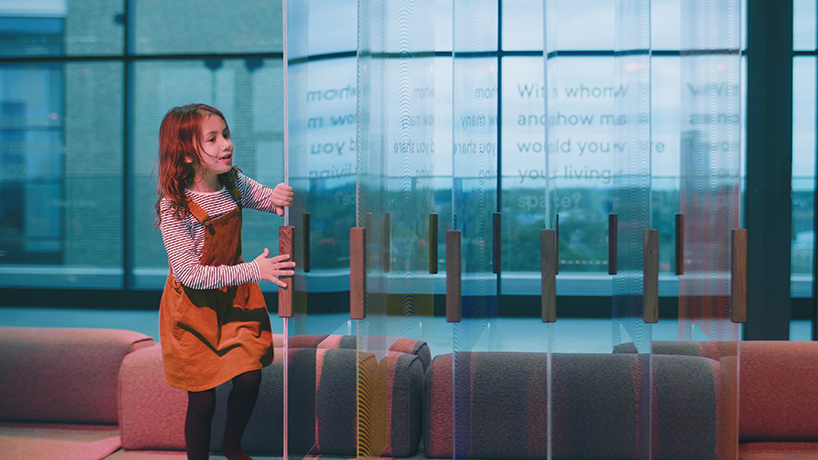
the interactive installation provides a space of both refuge and play
video © JHB visuals

finding a balance between privacy and social interaction

can the right filters in shared space help us switch between social contact and the need for privacy?

as you shift the panels, the soundscape – designed by mark ijzerman – changes to represent more intimate versus more social living environments

how to find solitude in a shared living space?
project info:
project name: filter family
location: eindhoven, dutch design week 2019
client: leolux
design: studio LONK
collaborators: mark ijzerman (sound design & software), jaromir mulders (sound electronics) and daniël maarleveld (moiré patterns)
photography: zebra fotostudio’s
film: JHB visuals
designboom has received this project from our ‘DIY submissions‘ feature, where we welcome our readers to submit their own work for publication. see more project submissions from our readers here.
shop
your own online design shop — no sales commission collected