timber shell system fuses polygonal framing & reciprocal bracing for efficient construction
with a free-form design optimized for fabrication and assembly, it introduces an optimized level of efficiency and precision in timber construction.
prefer designboom on google[FEATURED]
reciprocal shell redefines possibilities of timber structures
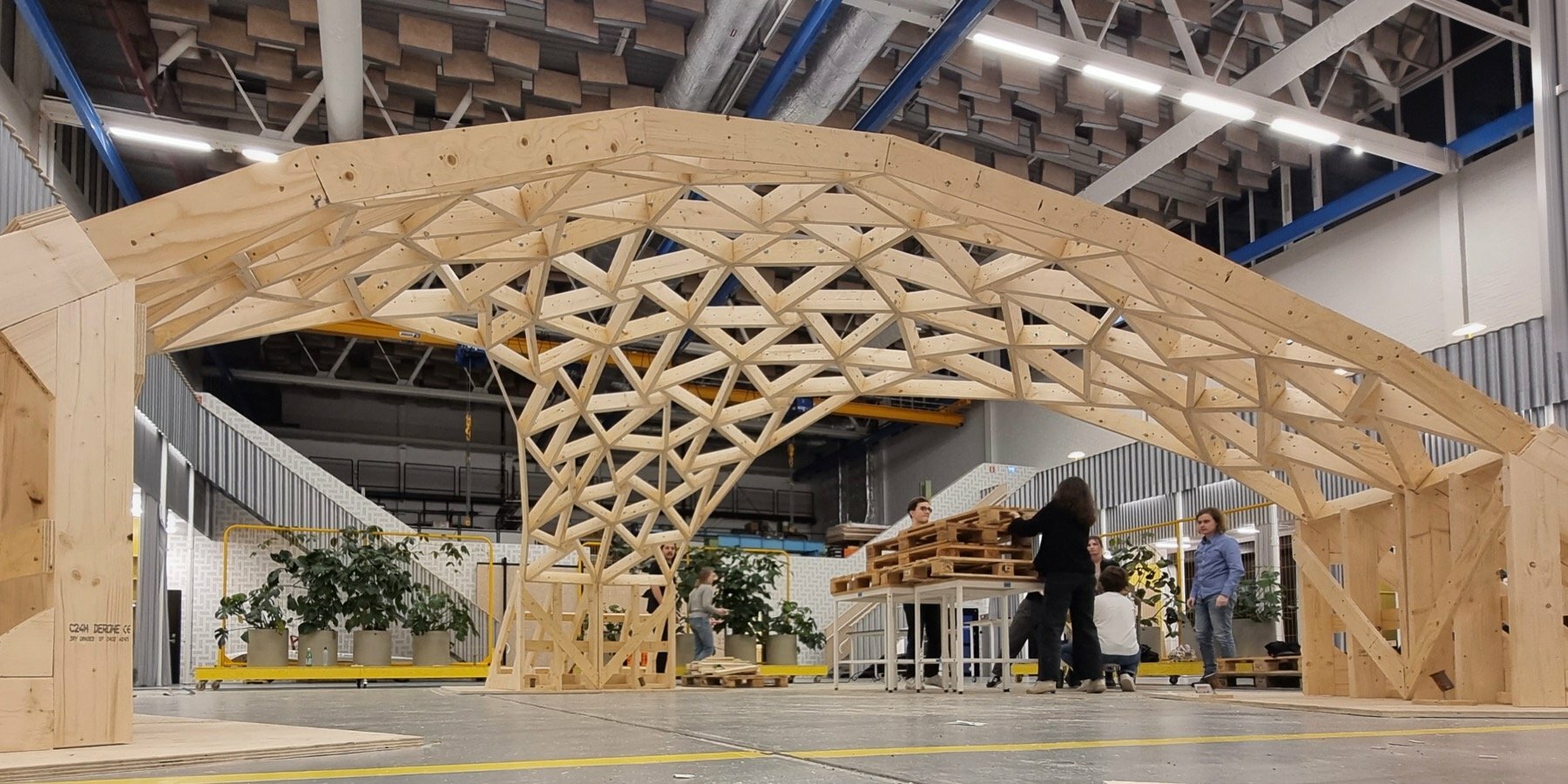
A collaborative effort between Chalmers University of Technology and Augsburg University of Applied Sciences, Reciprocal Shell explores how innovative timber systems can transform architectural possibilities. Crafted by a team of researchers and students, the lightweight structure challenges preconceptions of timber’s potential. With a free-form design optimized for fabrication and assembly, utilizing nothing more than a saw blade, it introduces a level of efficiency and precision previously unattained in timber construction. The primary topology features planar polygonal facets which ensure a consistent distance offset for thickness, and integrate cross-bracing through a reciprocal configuration of wood beams.

Chalmers University teams up with Augsburg University
Supported by Chalmers University of Technology and the FNR research project No. 2220HV001X / .TSI, the Reciprocal Shell showcases the convergence of innovation, technology, and craftsmanship. This venture seeks to pioneer a new era in digitally prefabricated wooden structures with wood-wood connections, to redefine the limitless possibilities in the future of timber architecture. Notably, its design overcomes geometric challenges posed by free-form shell shapes, unveiling a structure that boasts extraordinary strength and stability.
This hybrid timber system marries cutting-edge robotics with timber construction. The polygonal framing aspect ensures a constant distance offset for the shell’s thickness, while simultaneously, the reciprocal configuration facilitates cross-bracing within the structure, overcoming geometric constraints in free-form surface structures. To tackle geometric challenges, the system places reciprocal nodes at the center of the polygons, simplifying joint connections and offering impressive load-bearing capacity. Their significance is magnified by their ability to surpass traditional joint connections involving five to six beams converging at a single point.

To showcase the practical application and limitations of this timber system, the design team embarked on a case study featuring a small-scale shell demonstrator. This structure spans up to 7.5 meters and is composed of 144 wood elements for each of the polygonal and reciprocal configurations. The results of this study highlight the system’s ability to facilitate rapid and precise assembly and disassembly of prefabricated timber structures. Additionally, one of the key drivers of this system’s efficiency lies in its ability to generate similar yet distinct solid elements, driven by a customized CAD data interface that streamlines the automated production of numerous components. This, in turn, simplifies joint details, making alignment and attachment of beams straightforward, reducing design complexity and easing the construction phase.
The timber system achieves remarkable precision for fabrication through a multi-axis robotic setup, utilizing a saw blade for rapid, precise, and accurate cuts and grooves, ensuring each component fits together seamlessly. Both timber configurations are designed to produce a uniform distribution of beam sizes, minimizing offcuts. This sustainable approach allows architects and builders to maximize the use of cost-efficient, short solid wood pieces.




project info:
name: Reciprocal Shell
designers: Chalmers University of Technology, Augsburg Technical University of Applied Sciences
researchers: Amin Adelzadeh, Hamed Karimian, Karl Åhlund, Jonas Lundberg, Prof. Dr. Christopher Robeller (Chalmers Jubilee visiting Professor 2022)
students: Agathe Ducos, Adrien von der Weid, Alexandra von Bartschikowski, Anne Wicklein, Clément Braekevelt, Edith Tamm, Edona, Ege Can Yazici, Erika Perleroth, Felicia Raunås, Felix Bossenmaier, Herman Ehrnberg, Jael Kahlenberg Caso, Jakub Maliborski, Katharina Harre, Lina Svantesson, Linn Appelgren, Lluc Chia Colomer, Lorenzo Mulatero, Lukasz Gnatek, Madalin Manu, Maija Virkki, Mauritz Renz, Natasha Zwarts, Nina Tran, Nora Reis, Parjaree Manuch, Rick Persson, Rikard Murgård, Sakurako Matsuoka, Samira Sarreshtedari, Sara, Murphy Colome, Selina Ahrens, Selina Christ, Simon Ciompi, Simon Wikström, Sofia Deixelberger, Theresa Haase, William Havner, Ziming Wang.
supported by: Chalmers University of Technology and FNR research project No. 2220HV001X / .TSI
designboom has received this project from our DIY submissions feature, where we welcome our readers to submit their own work for publication. see more project submissions from our readers here.
shop
your own online design shop — no sales commission collected