
numa immersive projection system rethinks elevator as responsive spatial environment
set within one of the most overlooked transitional and confined spaces, numa introduces a projection system that transforms the elevator cabin into a responsive environment, reshaping how enclosure is experienced.
prefer designboom on google[FEATURED]
numa applies projection to redefine confined elevator spaces
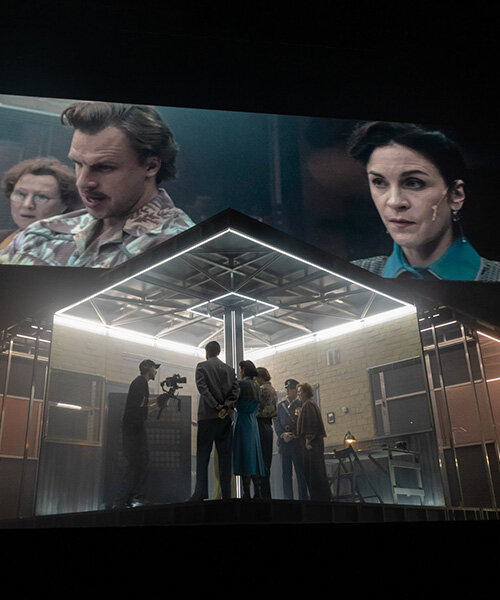
NUMA is an immersive projection-based system that reconsiders the elevator cabin as a responsive spatial interface. Developed by interaction designer and creative technologist Shimin Gu, the project addresses the experiential qualities of elevators, which are typically defined by technical and functional requirements rather than spatial perception. The system introduces a visual layer that operates independently of the existing structure. Instead of altering the physical enclosure, NUMA uses projection to modify how the space is perceived, allowing it to be implemented across different elevator types without structural intervention.
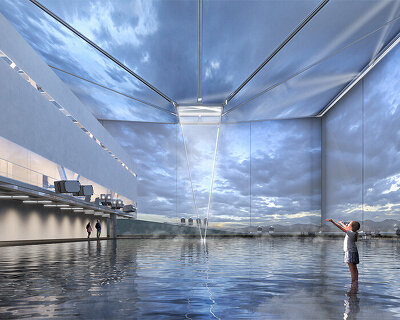
At the core of the system is a ceiling-mounted projection unit combined with a spatial scanning mechanism. The scanner reads the geometry of the cabin in real time, enabling automatic alignment of projected content across varying dimensions. This configuration supports a retrofit approach, eliminating the need for manual calibration or reconstruction. Projection is concentrated in the upper peripheral areas of the cabin, preserving the legibility of the existing interior. Visual content includes slow-moving sequences derived from open environments, such as skies and landscapes, as well as abstract compositions. These elements introduce a sense of visual depth and continuity, reducing the perceived enclosure without establishing a dominant focal point.

responsive projection adjusts spatial perception in real time
NUMA operates through two distinct modes, defined by different conditions of use. In standard operation, projection remains limited and peripheral, maintaining a minimal level of visual intervention. The system remains present but does not interfere with typical user behavior. In emergency conditions, such as prolonged stops or system disruption, the projection expands to cover the full interior surface of the cabin. This shift alters the spatial perception at moments when enclosure may become more pronounced. An integrated battery allows the system to continue functioning during power interruptions, operating independently from the elevator’s primary system.
The transition between modes occurs automatically, based on predefined parameters informed by behavioral research. A study involving 317 participants contributed to the development of variables such as projection coverage, movement speed, and timing. These parameters translate observed responses to confined environments into spatial adjustments. NUMA positions projection as an infrastructural layer that operates alongside the mechanical system of the elevator. By focusing on perception rather than physical modification, the project reframes the elevator cabin as a space where environmental conditions can be adjusted in response to user experience.


project info:
name: NUMA Immersive Projection System
design team: Shimin Gu | @gu.simi, Xuanchen Li, Yixuan Huang
designboom has received this project from our DIY submissions feature, where we welcome our readers to submit their own work for publication. see more project submissions from our readers here.
shop
your own online design shop — no sales commission collected