self-powered floating capsule disinfects drinking water without batteries or chemicals
developed by researchers at yonsei university and international collaborators, the floating device converts simple movement into energy for water testing and microbial disinfection.
prefer designboom on google[FEATURED]
self-powered capsule tests water quality
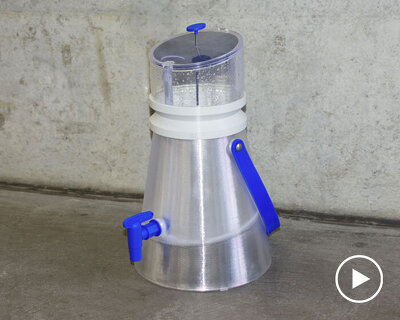
Researchers from Yonsei University in South Korea, working with collaborators from the University of Bath, Renmin University of China, and the Korea Institute of Science and Technology, propose a self-powered floating capsule that detects water quality and disinfects microorganisms without batteries, external power sources, or chemical additives. Published in Nature Water, the study presents an all-in-one device designed for decentralized water treatment, addressing a global challenge that continues to affect billions of people without reliable access to safe drinking water.
The floating-induced detection-guided disinfection (FDGD) capsule combines water monitoring and purification within a compact, low-cost system. Users activate the first stage by shaking the capsule for approximately three seconds. This movement drives an internal electromagnetic generator that produces enough electricity to measure total dissolved solids (TDS), a commonly used indicator of water quality, and wirelessly transmit the results to a smartphone or smartwatch through Bluetooth connectivity.

floating device disinfects through motion
Once the capsule confirms that dissolved solids remain within acceptable levels, it automatically initiates a disinfection process. The device harvests energy from gentle movement, while floating inside a water container, without relying on filters, chlorine, ultraviolet light, or rechargeable batteries.
Its dielectric outer shell accumulates electrostatic charges at the interface between the capsule and the surrounding water. These charges concentrate at microscopic nanorod structures on the capsule’s surface, generating localized electric fields strong enough to disrupt microbial cell membranes through electroporation. The process neutralizes bacteria and other microorganisms without introducing chemical residues into the water.
Laboratory testing demonstrated more than a six-log reduction of microbial contamination, equivalent to eliminating over 99.9999 percent of microorganisms. Researchers report that the capsule maintained its performance through more than 120 treatment cycles and operated in containers holding up to four liters of water.

decentralized approach to safe drinking water
The project contributes to growing research into decentralized water technologies that can function independently from large-scale treatment networks. While portable purification systems already exist, many depend on consumable filters, chemical treatments, ultraviolet lamps, or rechargeable power sources. By harvesting energy directly from human motion and environmental movement, the FDGD capsule seeks to reduce those dependencies.
The device points toward potential applications in disaster relief, humanitarian response, outdoor recreation, and remote communities where access to electricity remains limited. Although further testing outside controlled laboratory conditions will be necessary before commercialization, the research proposes an alternative model for water safety that combines monitoring and treatment within a single self-powered object.


project info:
name: floating-induced detection-guided disinfection (FDGD) capsule
research team: Min Jae Park, Dong-Min Lee, Zheng-Yang Huo, Sungjin Cho, Fengyi Pang, Sung Soo Kwak, Young-Jun Kim, Chris R. Bowen, Ming Xie & Sang-Woo Kim
institutions: Yonsei University, University of Bath, Renmin University of China, Korea Institute of Science and Technology
publication: Nature Water
shop
your own online design shop — no sales commission collected