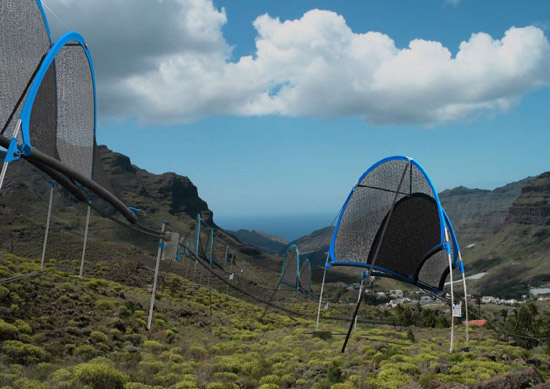
‘dropnet’ installed on hillside
the ‘dropnet’ by german designer imke hoehler is a fog collector which has the potential to provide drinking water supplies to to isolated areas or areas with low infrastructure. using natural and local resources, the collector filters tiny water droplets from fog clouds causing the droplets to coalesce.
the tent-like construction of the ‘dropnet’ is easy to assemble, with a total height of 3 metres and width of 4.5 metres, giving it a net surface of ca. 6 metres squared. it is made from an inexpensive mesh of polypropylene, which is a special fabric using horizontal and vertical fibers to create a triangular pattern. the net needs to be tensed, so that it shows curvature in two directions, thus building a saddle surface that creates a stiffness which is durable enough to resist strong winds. water is collected via drain gutters which are connected to the net by weltings, draining the water into a small tank. an integrated filter within, cleans the water before it is distributed.
the dropnet has been designed to be built up on flat and uneven ground in situations with or without hillsides. the best conditions for installing the fog collectors are in especially arid,coastal areas with altitudes between 400 m and 1200 m which exhibit a lot of fog accumulation. such locations include chile, haiti, peru, nepal, spain etc. depending on the conditions, ‘dropnet’ can collect 10 to 20 liters of water per m2 a day.
if a number of collectors are installed together and connected to pipelines, they have the capacity to supply a small village with enough drinking water.
 ‘dropnet’ installed on hillside designboom asked imke hoehler to discuss her ‘dropnet’ project further:
what was the starting point for ‘dropnet’? my bachelor – thesis, supervised by prof. ulrich hirsch, had the subject’drinking water abstraction world wide’. we were three students choosing the subject for our final thesis. for about one month we collected information together about drinking water shortages, existing solutions, concept ideas and their advantages and disadvantages. through this research I also heard about the fog collectors in south america installed by the canadian non-profit organization fogquest.
my two mates found interesting subjects within the area of desalination. but I found the project about fog collection the most interesting and have been fanscinated by the low-tech idea of water abstraction using natural resources. so I read more about fog collectors and found outthat their construction (looking like volleyball nets) is not very resistant against wind (which is not very surprising) and, that most of the collectors have been destroyed after a short term. I thought that there was much more potential in the idea of fog collection and after some email exchange with prof. otto klemm (professor for climatology in münster, germany, and conference host of the 5th international conference on fog, fog collection and dew) I was convinced that my thesis project should be about fog collection.
 ‘dropnet’ situated in a fog cloud
through your research, how did you arrive at this particular form for the dropnet? I just wanted to create a construction that is very wind-resistant and can be set-up as easily as a tent and maybe also stuffed in a bag like a tent, so it won’t need too much space during its transportation. I created little models from wire and fly-screens to test the forms and their water draining capacities. during this experimental phase I have also been supervised by prof. dieter zimmer, who has been the project leader of prof. frei otto’s project ‘olympic roofs, munich 1972’. so you see which examples inspired me and led me to the final lightweight construction.
 frei otto’s project ‘olympic roofs, munich 1972’ image courtesy of mc gill university can you explain the technical process of how the mesh fog collector filters the droplets? locations suited for fog collectors are especially arid, coastal areas with altitudes between 400 and 1200 m, that show a lot of fog accumulation. the fog type ‘advection fog’ is very suitable and can be hundreds of meters thick. advection fog occurs when moist air passes over a cool surface by advection (wind) and is cooled. advection fog can easily be accompanied by force 8 winds. the tiny droplets of the fog are blown against the tensed mesh. the wind can pass the mesh, while the droplets remain. if many droplets converge, they form bigger drops and run down the mesh to the drain gutters. from here the drops coalesce and follow the gutters to the little water tank, where the water is cleaned before it is transfered to the pipeline. if the prevalent wind is very strong, it can happen that some droplets are pressed through the mesh and fall down without being caught by the drain gutters. therefore dropnet has got a bigger, second mesh behind the first one. it can catch the droplets which escaped the first mesh. it is important that both nets are tensed very well, because tests (also my tests with my models from wire and fly-screen) have shown that like this the droplets can be collected much more effective.
 extracting a water sample from the collector
 isolated mountain village in peru
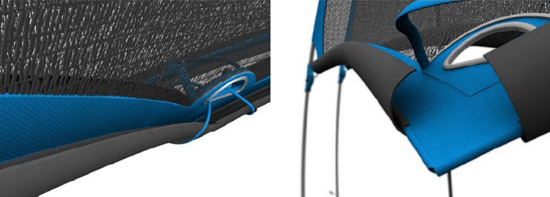 drain gutters are connected to the net by weltings
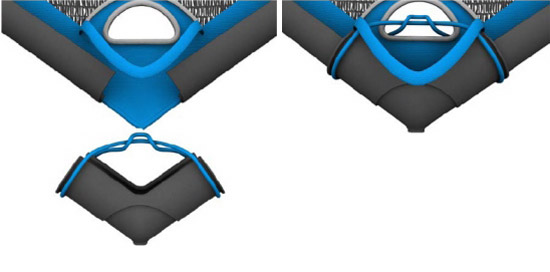 drain gutters
 pipelines lead water from the fog collectors to big water tanks for distribution
 drawings of the ‘dropnet’ set-up
 ‘dropnet’ dimensions
via inhabitat
rain water collectors (18)
 Apr 23, 2025
 Mar 19, 2025
 Feb 10, 2025
 Feb 10, 2025
 Jan 23, 2025
 May 29, 2025
 May 22, 2025
 Apr 16, 2025
 Apr 14, 2025