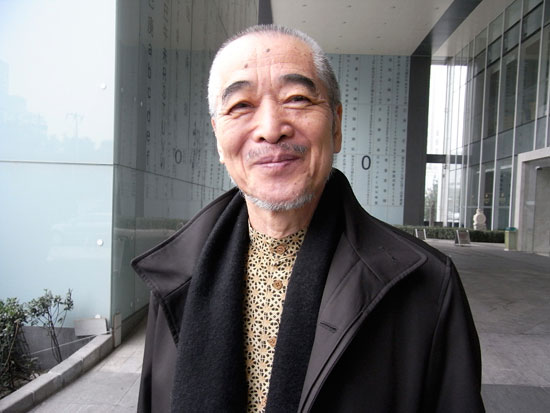
kohei sugiura portrait © designboom
at the recent icograda world design congress in beijing, the japanese graphic designer kohei sugiura gave a lecture entitled ‘one is two, two is many, and many returns to one’.
we quote here: ‘that’s the flow of yin and yang.yin and yang seem to be two things and in fact have different meanings but canbe combined into one’.I often use our fingers as a metaphor. the ten fingers stand for many. this one can be science, this one the society, this one the environment… but they all stem from the same origin, the one. people nowadays tend to make things more and more complex, as in thenonstop development of science. yet they don’t know how to return to the origin, and this I think is the problem.one contains two and many, and, many will return to one.you should nurture yourself with all the information, all the pictures and texts, and try to make them one.’
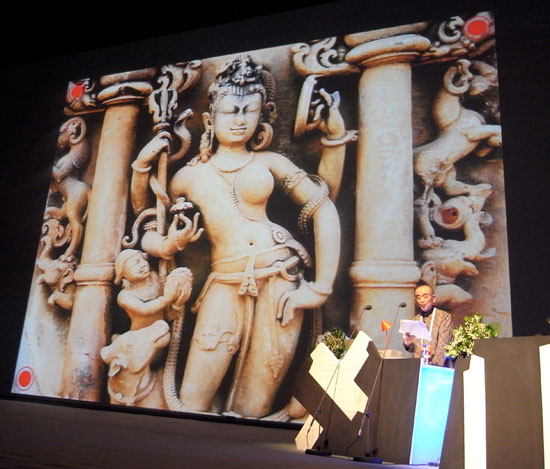 hindu goddess ardhanarishvara -half male and half female kohei sugiura at the icograda world design congress in beijing, 2009 image © designboom
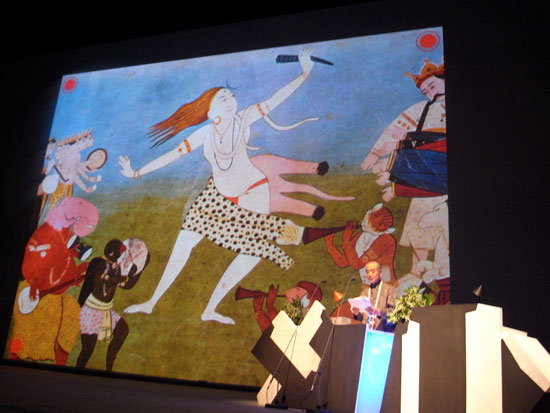 the two opposing powers of destruction … and reconstruction kohei sugiura at the icograda world design congress in beijing, 2009 image © designboom
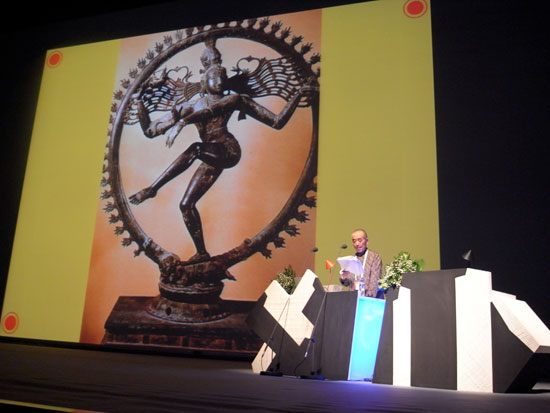 nataraj, the dancing form of hindu goddess shiva symbolizes the cosmic cycles of creation and destruction, as well as the daily rhythm of birth and death. the dance is an allegory of the five principle manifestations of eternal energy: creation, destruction, preservation, salvation, and illusion. kohei sugiura at the icograda world design congress in beijing, 2009 image © designboom
sugiura is a major researcher of mandalas and other asian iconography. he promotes the study of the conscious and unconscious making, perception and representation of man-made forms, equally built, painted, sculpted or performed, both of the past as well as of the present. he showed many examples of symbols and other forms of expression from many different parts of the world, designs whose origins and transformations are inseparable from the various ethnicities and cultures, but can be recognized as part of a unifying family. a perspective that faces the whole of creation and grasps the existence of the universe in a single seed.
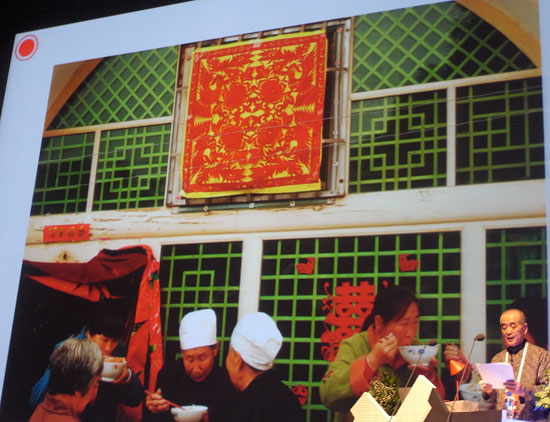 around the first century A.D., the chinese invented that most flexible, versatile and adaptable of materials – paper. the ancient chinese paper cutting or jianzhi reflects many aspects of life such as good luck, prosperity, health, or harvest. the oldest surviving paper-cut is from the 6th century. from the 7th to the 13th centuries, it became very popular and was spread to the rest of the world in the 14th century
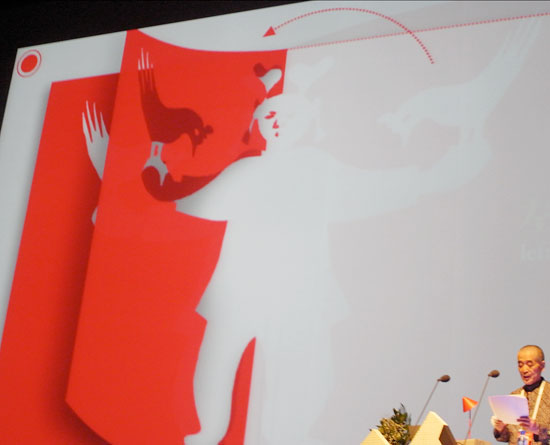 there are basic cut outs, that are a single image and there are symmetrical designs that are usually created by some folding over a proportioned crease, and then cutting some shape. when unfolded, it forms a symmetrical design. the art of paper cuts is passed down from generation to generation.
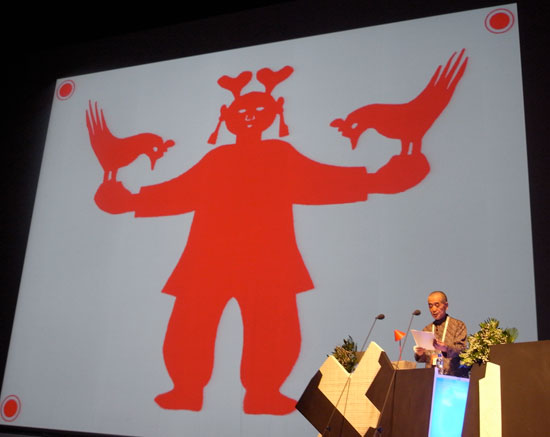 the unfolded paper reveals symmetry
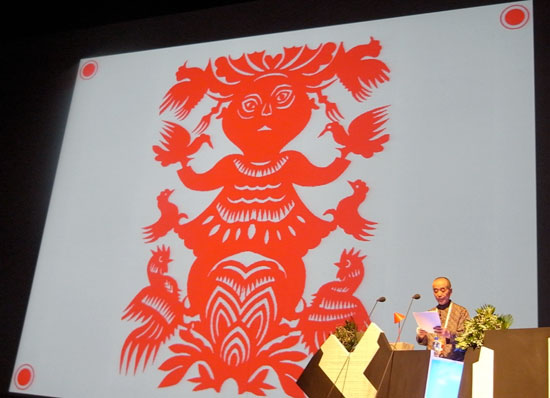 ‘many’ come out of ‘two’ which come out of ‘one’ kohei sugiura at the icograda world design congress in beijing, 2009 image © designboom
the yin yang or tai chi symbol is recognised throughout the world as an icon represented in a number of belief systems and as a component of the national flag of south korea. history does not record when or where the yin yang symbol originated, though it first appeared in chinese records over four thousand years ago. it seems reasonable, therefore, to suggest that it originated in china.
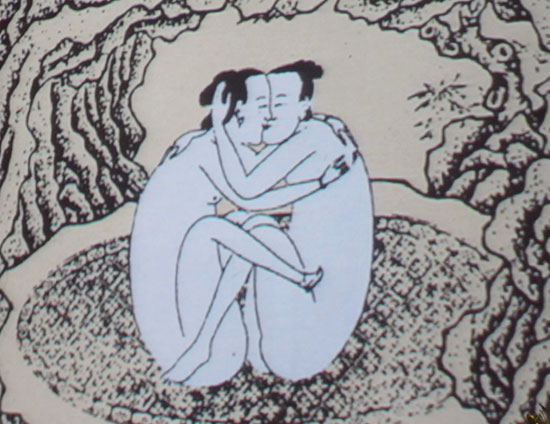 return to the completeness of the beginning kohei sugiura at the icograda world design congress in beijing, 2009 image © designboom
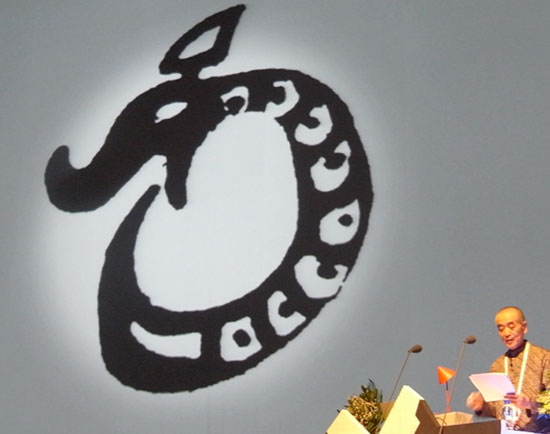 the ‘ouroboros’ or ‘uroborus’ kohei sugiura at the icograda world design congress in beijing, 2009 image © designboom
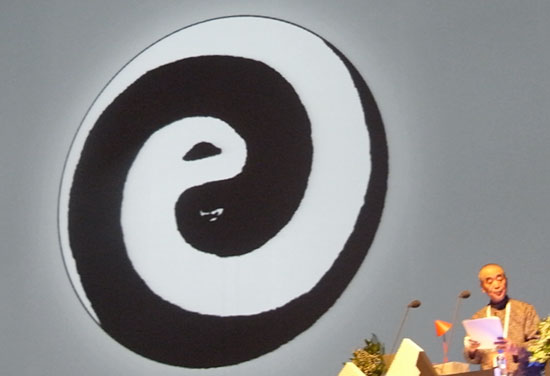 the coils of snakes kohei sugiura at the icograda world design congress in beijing, 2009 image © designboom
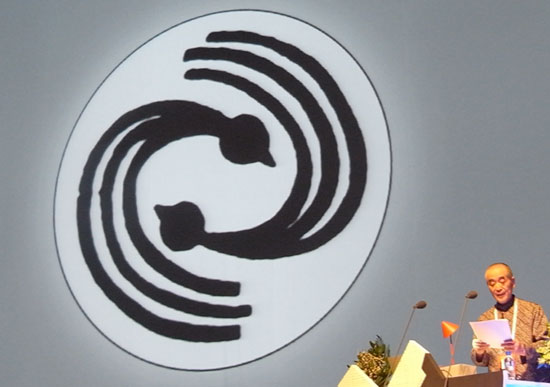 male and female birds kohei sugiura at the icograda world design congress in beijing, 2009 image © designboom
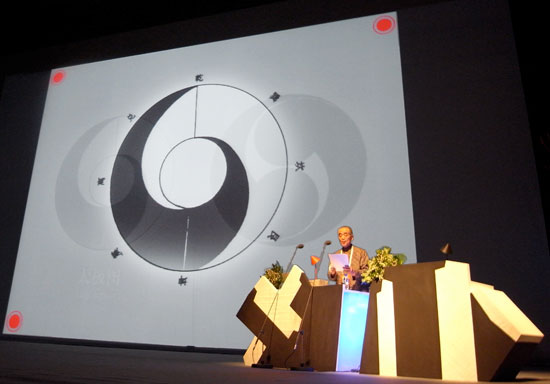 the tai chi diagram changes from bipolar to tripolar kohei sugiura at the icograda world design congress in beijing, 2009 image © designboom
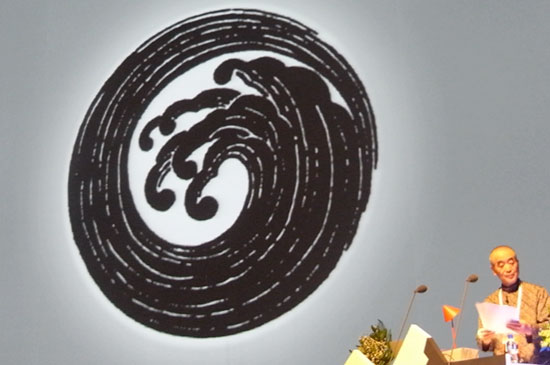 … transforming into waves and clouds kohei sugiura at the icograda world design congress in beijing, 2009 image © designboom
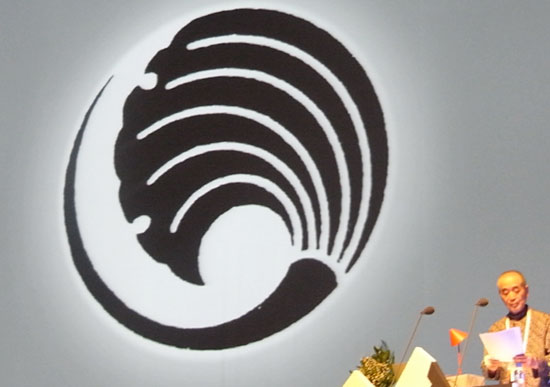 … into all kinds of plant pattern kohei sugiura at the icograda world design congress in beijing, 2009 image © designboom
part 1 video © designboom
part 2video © designboom
sugiura developed his own theory of visual communication and the essence of typography. to make information vivid, not cool. ‘today’s western typography tends to keep the content quiet, very peaceful.’ he says‘ the world appears very peaceful. but actually, it’s not. during the cultural revolution in china, people wrote many words on the wall, transformed the wall into a newspaper. some words were big, some words were small. the overall result was very noisy but brought out the people’s energy of action.’
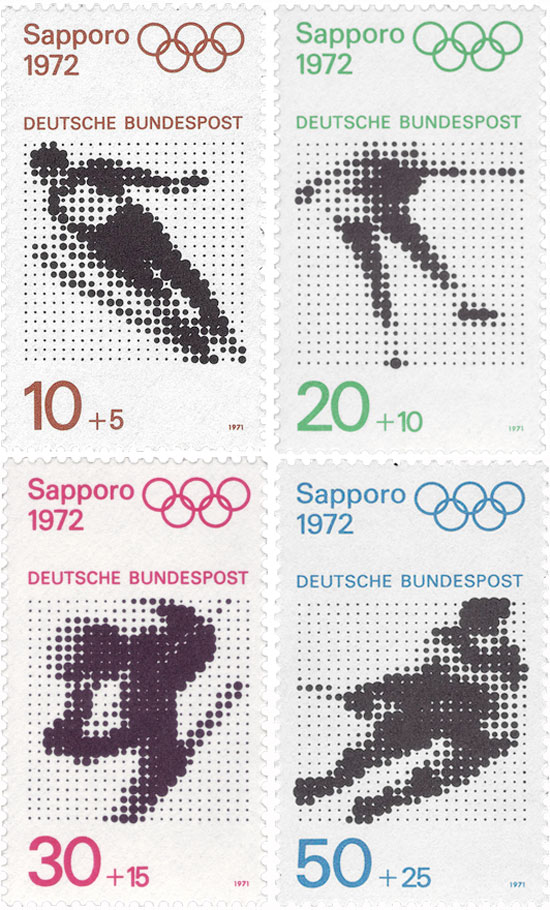 series for olympic games 1972, sapporo and munich graphics by kohei sugiura, first day of issue june 4, 1971 image courtesy kohei sugiura
kohei sugiura was born in tokyo in 1932. he graduated from tokyo university of fine arts and music with a degree in architecture. he has been a graphic designer for five decades, and is a recognised innovator, especially in the area of book design. sugiura taught at the ulm school of design in germany from 1964 to 1967, and at kobe design university from 1989 to 2003. he has written extensively about visual communication, perception, music, and iconography, with a particular focus on the cultural traditions of asia. among them ‘asian and japanese forms and designs’, ‘swallowing up the universe’,’spirits of form and design’, ‘drumming the cosmos’, ‘wind and lighting: a half-century of magazine design by kohei sugiura’, ‘books, texts, and design in asia’, and ‘luminous mandala: book designs of kohei sugiura’. sugiura has received numerous awards, including the special prize at the leipzig book design fair, the mainichi newspaper arts prize, and the arts award from japan’s ministry of education. in 1997, he received the medal of honor with purple ribbon from the japanese government.
icograda congress beijing 09 (6)
 Dec 15, 2009
 Nov 20, 2009
 Nov 18, 2009
 Nov 13, 2009
 Sep 02, 2009
 May 27, 2025
 Apr 28, 2025
 Apr 02, 2025
 Jan 21, 2025