
‘capture the rain’ skyscraper by ryszard rychlicki and agnieszka nowak
polish architectural students ryszard rychlicki and agnieszka nowak of H3AR received a special mention for their proposal in the 2010 skyscraper competition.
‘capture the rain’ skyscraper is a building whose roof and external shell, which consists systems of gutters, are aimed at capturing as much rainfall as possible to meet the daily needs of its inhabitants. average daily consumption of water per person is 150 liters, out of which 85 liters may be replaced by rain water. within the last thirty years water consumption has significantly increased. there are lots of factors that contribute to such an increase such as increasing number washing machines and dish washers, increasing popularity of garden showering devices and flushing toilets. a third of water being used in households in western countries is flushed in toilets. since 1900 the total water consumption in the US has increased by 1000%. at present, an average american uses five times more water that a citizen of developing countries. such an increase is related to among others improved living standards. on the other hand, a national hobby of the danes is collecting rain water for washing and watering plants. within the last ten years average use of pure water in denmark dropped by 40% and inhabitants of the so called eco-villages use a third part of the national average.
in view of this data, they decided to design a tower, whose structure will allow for capturing and processing as much rainfall as possible to provide with water for its inhabitants. millennia plants have been developing systems of capturing and processing rainfall. such systems helped them to deal with water deficits or surpluses. similarly, they wanted to copy their simple mechanisms of rainfall capturing and processing. initially, in designing the tower, we focused at shaping and modeling the surface of the roof to capture as much rainfall as possible. under a roof’s surface, there are water reservoirs in the form of a large funnel and reed fields, which serve as a hydro botanic water treatment unit. the unit processes water into usable water that is further transmitted to apartments. a network of gutters on the external surfaces of the building is designed to capture rainfall flowing down the building. such flowing rainfall is transmitted to floors and its surplus is stored in a reservoir under the building. water captured and processed by the building may be used for flushing toilets, feeding washing machines, watering plants, cleaning floors and other domestic applications. having analyzed rainfall in several large cities in developed countries, we obtained a formula that shows what percentage of daily pure water consumption may be replaced with rainfall thanks to the technology applied in their building.
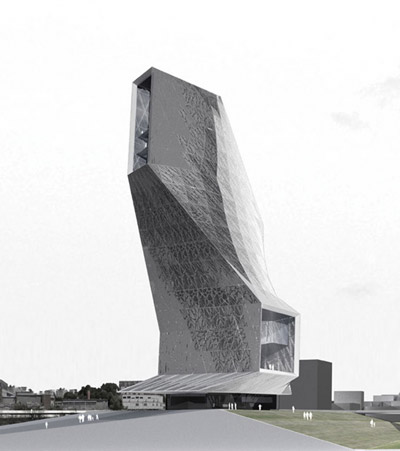
 top section of ‘capture the rain’
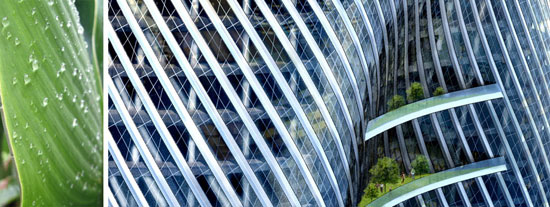 detail of balcony
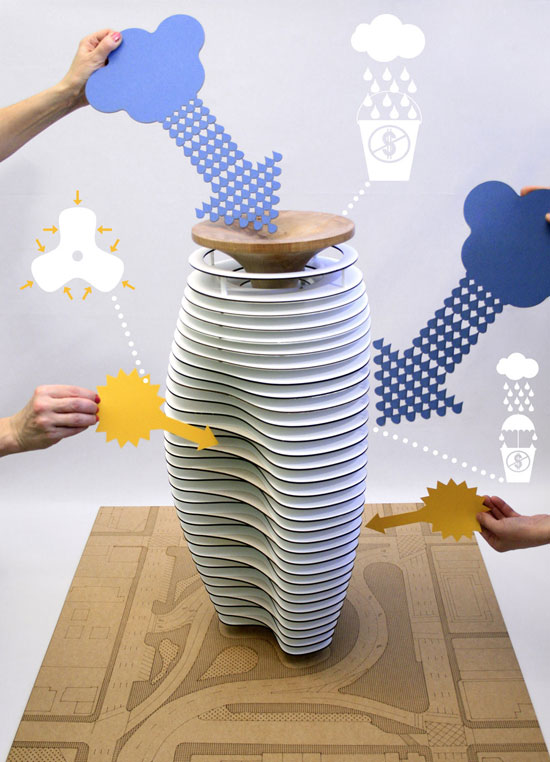 how the rain contributes to the rest of the building
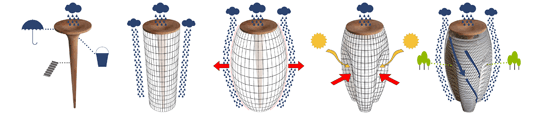 the funnel which is at the core of the building

 water consumption table
  the water is reused and circulated around the building
project info: rain collector and skyscraper design- ryszard rychlicki, agnieszka nowak ( www.h3ar.pl) 4th year students of architecture academy of fine arts in poznan poland special mention-2010 skyscraper competition evolo
2010 skyscraper competition (13)
 Mar 18, 2010
 Mar 18, 2010
 Mar 17, 2010
 Mar 16, 2010
 Mar 16, 2010
architecture in poland (170)
 May 23, 2025
 May 17, 2025
 Apr 11, 2025
 Feb 24, 2025
 Dec 30, 2024
h3ar (5)
 Mar 29, 2010
 Mar 09, 2010
 Dec 23, 2009
 Aug 11, 2009
rain water collectors (18)
 Apr 23, 2025
 Mar 19, 2025
 Feb 10, 2025
 Feb 10, 2025
 Jan 23, 2025
 May 23, 2025
 May 19, 2025
 May 15, 2025
 May 14, 2025